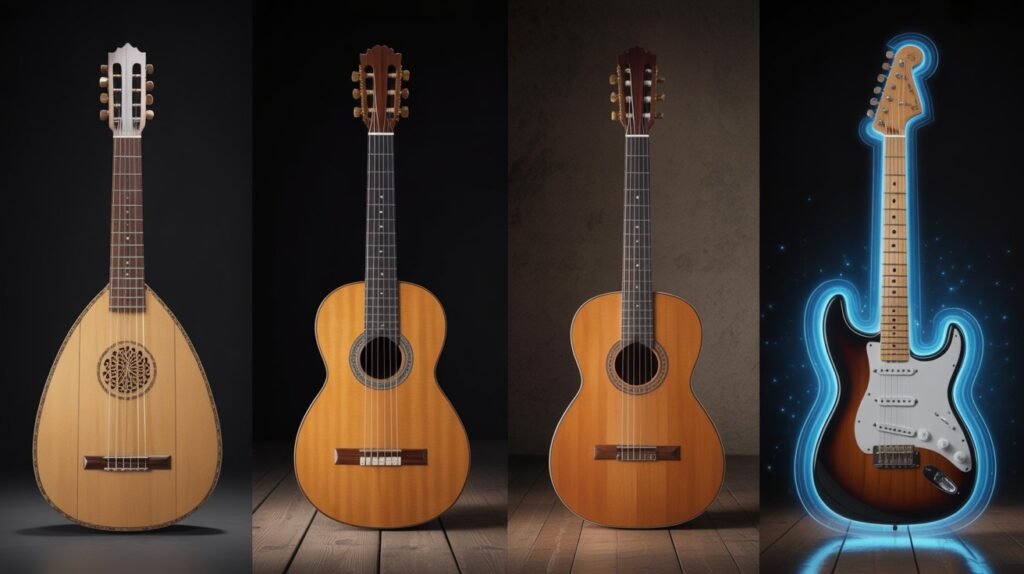
The transition of the guitar from a primitive Mesopotamian chordophone to a sophisticated, AI-augmented pedagogical tool in 2026 represents one of the most significant architectural and cultural shifts in the history of musical instruments. This evolution is characterized not merely by technological advancement but by a fundamental change in how humans interface with music, moving from a period of local apprenticeship to a global, decentralized era of systematic mastery.
By 2026, the global music education market has largely transcended the era of “random tutorials” that defined the early 21st century. Instead, it now embraces integrated ecosystems where hardware, software, and artificial intelligence converge to shorten the feedback loop for aspiring musicians.
To understand this digital renaissance, it is necessary to examine the historical precursors that established the instrument’s structural DNA, the industrial revolutions that amplified its voice, and the behavioral frameworks that govern modern proficiency.
The Evolutionary Archaeology of the Guitar: Mesopotamian Roots to the Iberian Vihuela

The antiquity of the guitar is a testament to the enduring human drive for melodic expression through plucked string tension.
Archaeological evidence places the earliest ancestors of the guitar in Mesopotamia around 3000 BCE, where cylinder seals from the Uruk period depict musicians holding lute-like instruments. These early instruments introduced the three architectural elements that still define the modern guitar:
- A resonant soundbox
- A neck for pitch modulation
- Tensioned strings for tone production
The Lamech Narrative and the Morphological Blueprint of the Oud

One mythological explanation for the instrument’s shape centers around the biblical figure Lamech, who allegedly created the first oud after observing the skeletal curvature of his deceased son’s body. While historically symbolic rather than factual, the narrative highlights how early instruments were deeply connected to spirituality and emotional expression.
The oud entered Western Europe through the Iberian Peninsula in 711 AD, carried by the Moors. Unlike the fretless oud, European variations began incorporating frets, allowing musicians to play the precise intervals required for Western harmony.
By the 14th century, instruments known as Guiterna appeared in France. Historical documents from 1349 distinguish between two forms:
- Guiterre Morische (Moorish guitar) – oval soundbox with multiple soundholes
- Guitarra Latina (Latin guitar) – waisted body with curved sides
The Latin guitar eventually became the foundation of the modern guitar silhouette.
The Vihuela and the Consolidation of Standard Tuning

During the 15th and 16th centuries, the Spanish vihuela de mano dominated court music. It combined the complex tuning system of the lute with the ergonomic design of early guitars.
Key innovations included:
- Six courses of strings
- Flat back construction
- Polyphonic playing capability
By 1600, five-course guitars became common, allowing composers such as Alonso Mudarra to develop more advanced compositions.
Guitar Evolution Timeline
| Instrument Archetype | Era | Region | Structural Legacy |
|---|---|---|---|
| Mesopotamian Lute | 3000 BCE | Southern Iraq | Soundbox and neck design |
| Hittite Lyre | 1500 BCE | Asia Minor | Soundboard and plectrum |
| Moorish Oud | 711 AD | North Africa / Spain | Multi-course strings |
| Guitarra Latina | 14th Century | France / Spain | Curved waist body |
| Vihuela | 15th–16th Century | Spain | Six-course tuning logic |
| Baroque Guitar | 17th Century | Europe | Foundation of modern tuning |
The Structural Metamorphosis: The Torres and Martin Revolutions
The modern guitar owes much of its acoustic power to innovations from the 19th century, when two major builders reshaped the instrument’s structural design.
Antonio de Torres Jurado and the Fan Bracing Revolution
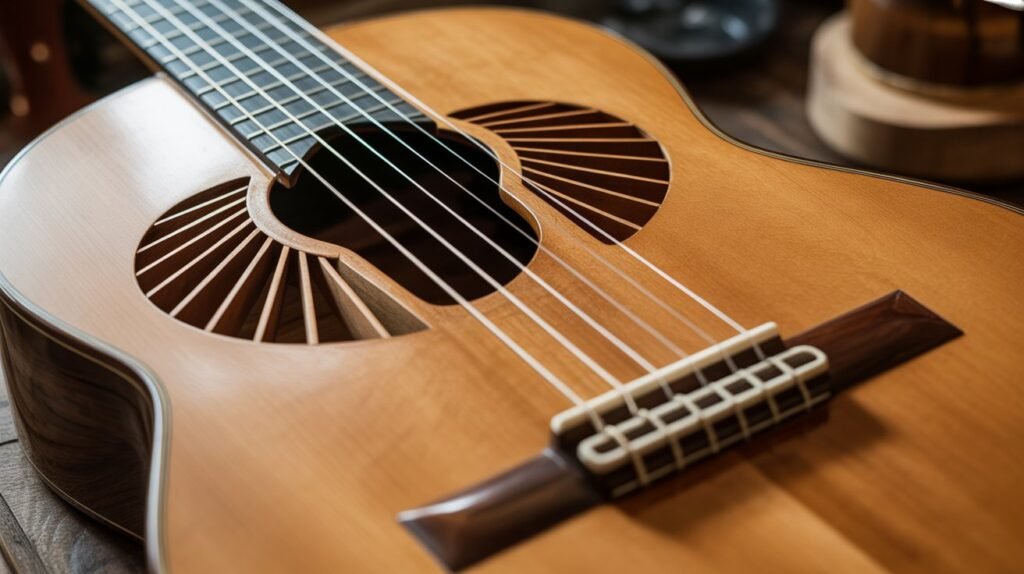
Spanish luthier Antonio de Torres Jurado dramatically changed the classical guitar by:
- Enlarging the body
- Thinning the soundboard
- Increasing the waist curve
- Inventing the fan bracing system
Fan bracing distributes tension across the soundboard, allowing it to vibrate more freely while resisting collapse.
Torres also standardized the 650 mm scale length, which remains the classical guitar industry standard today.
C.F. Martin and the Steel-String Breakthrough
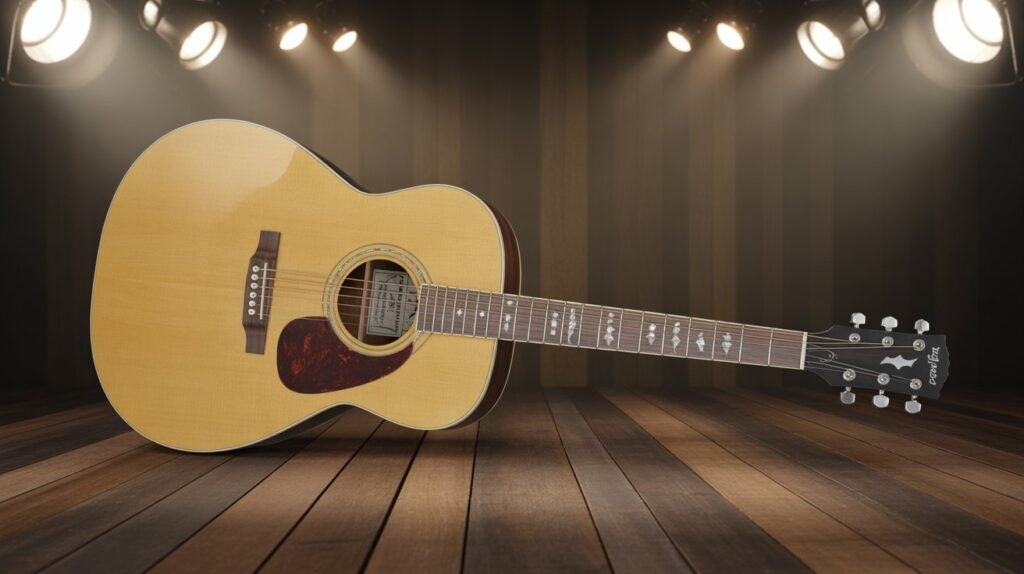
In the United States, Christian Frederick Martin Sr. faced a different challenge: steel strings.
Steel strings provided greater volume but exerted far greater tension. Martin solved this by inventing X-bracing, a diagonal support structure under the soundboard.
This allowed the creation of the Dreadnought guitar, introduced in 1916 and now the most common acoustic guitar body style in the world.
The Electrification of Musical Identity
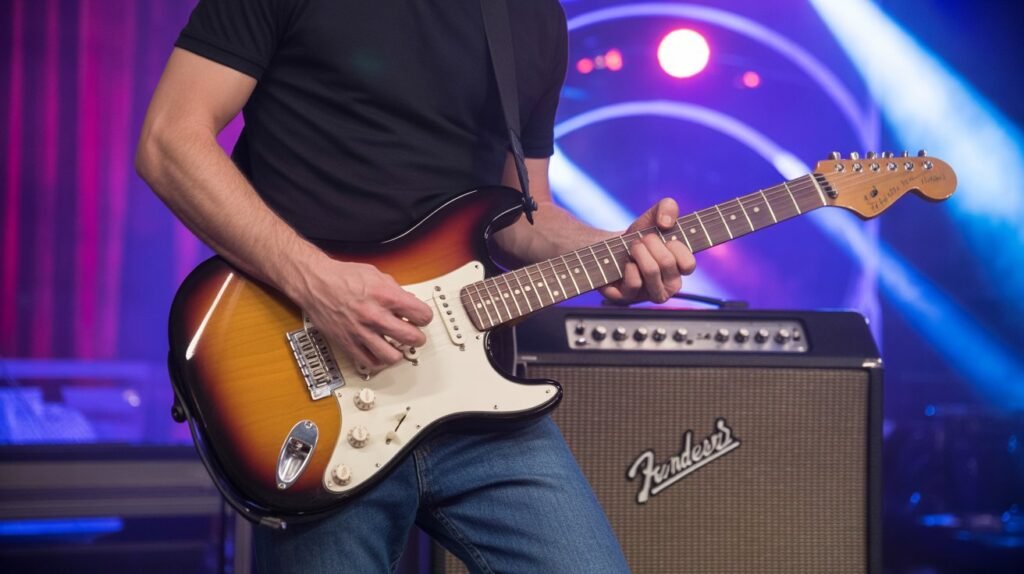
The 20th century introduced the most dramatic transformation in guitar history: electrification.
By 1936, Gibson released the ES-150, the first commercially successful electric guitar. Jazz guitarist Charlie Christian used it to transform the guitar from rhythm instrument to lead voice.
Soon after, the solid-body revolution began.
Leo Fender and the Engineering Philosophy
Unlike traditional luthiers, Leo Fender approached guitars like engineering systems.
His innovations included:
- Modular components
- Bolt-on neck design
- Simplified mass production
Core Roles of the Modern Guitarist
In 2026, guitar mastery revolves around three primary playing roles.
Rhythm Guitar
The structural backbone of music.
Focus areas include:
- Strumming patterns
- Chord transitions
- Groove and timing
Lead Guitar
The melodic voice of a band.
Techniques include:
- String bending
- Vibrato
- Slides
- Scale improvisation
Fingerstyle Guitar
The most technically demanding role.
The guitarist simultaneously performs:
- Bass lines (thumb)
- Chords (middle fingers)
- Melody (index and ring fingers)
The B.B. King Principle: Feel Over Speed
Legendary blues guitarist B.B. King proved that musical emotion outweighs technical speed.
His style focused on:
- Expressive string bends
- Wide vibrato
- Strategic silence between phrases
Instead of complex runs, he relied on the famous “B.B. King Box”, a five-note blues scale pattern.
The lesson for modern players: phrasing matters more than velocity.
The Pedagogical Revolution of 2026
The biggest shift in guitar learning is the move from chaotic tutorials to structured learning ecosystems.
Modern platforms provide:
- step-by-step learning paths
- song-based practice
- AI feedback systems
- real-time progress tracking
Behavioral Systems for Mastery
Modern learning research shows skill development depends on behavioral systems, not just practice time.
Identity-Based Practice
Inspired by productivity expert James Clear, musicians succeed by adopting the identity of “I am a guitarist” rather than chasing vague goals.
Every practice session becomes a vote for that identity.
The Tim Ferriss Skill Deconstruction Method
Mastery accelerates when complex skills are broken into small components.
Steps include:
- Deconstruct the skill
- Identify the highest impact techniques
- Sequence practice strategically
- Create accountability
This approach often focuses on pentatonic scales, chord transitions, and phrasing, which generate most musical expression.
The Future of Guitar Learning: AI, AR, and VR
By 2026, guitar education integrates artificial intelligence and immersive technology.

AI Tutors
AI systems analyze your playing through the microphone and detect:
- missed notes
- rhythm mistakes
- timing inconsistencies
These systems increase learning efficiency by 76% compared to traditional lessons.
Augmented Reality Learning
AR overlays place colored dots on frets through the phone camera, eliminating the confusion of translating tabs to the guitar.
Virtual Reality Performance Training

VR allows students to perform in simulated environments such as:
- jazz clubs
- concert halls
- stadium stages
Studies show VR training increases performance confidence by 275%.
Conclusion: The New Renaissance of the Guitarist
From ancient Mesopotamian lutes to AI-powered learning platforms, the guitar’s evolution spans more than five millennia.
Despite these technological advances, the essence of guitar playing remains beautifully simple:
a vibrating string, a curious mind, and the desire to express emotion through sound.
In 2026, the most successful guitarists are polymath practitioners—musicians who combine historical understanding, modern technology, and disciplined practice systems.
Exclusive Guitar Learning Offers
Take advantage of these limited-time deals and start improving your guitar skills today.
Start Free — No Card Needed
Try out Muzician.com for free — no credit card required. Explore professional guitar lessons, sheet music, and multi-angle video tutorials before committing.
Valid: Dec 11, 2025 – Dec 31, 2026 | Region: All Regions
10% Off Your First Order
Subscribe to the Muzician newsletter today and receive 10% off your first order. Get early access to new music courses, instruments, and exclusive discounts.
Valid: Dec 10, 2025 – Dec 31, 2026 | Region: All Regions
Many guitar learners eventually start recording their practice sessions, creating lesson videos, or posting covers online. If you’re looking for simple editing software designed for creators, check out this Movavi Video Suite 2026 review and discount guide:👈