The landscape of modern strength and conditioning is currently experiencing what the community calls a “major glow up,” moving away from the static, machine-heavy routines of the late 20th century toward high-mobility, functional tools that offer what athletes describe as “main character energy” for their joints and performance metrics. Central to this revolution is the Rage Fitness R2 Pull Sled, a piece of equipment that serves as a bridge between high-intensity interval training (HIIT) and specialized rehabilitative protocols. This report provides an exhaustive, 10,000-word deep dive into the engineering, biomechanics, and market positioning of the R2, explaining why it has become the “GOAT” (Greatest of All Time) for home gym owners and elite athletes alike who are tired of the “mid” results offered by traditional cardio.
Engineering the Scrape: Technical Specifications and Material Science
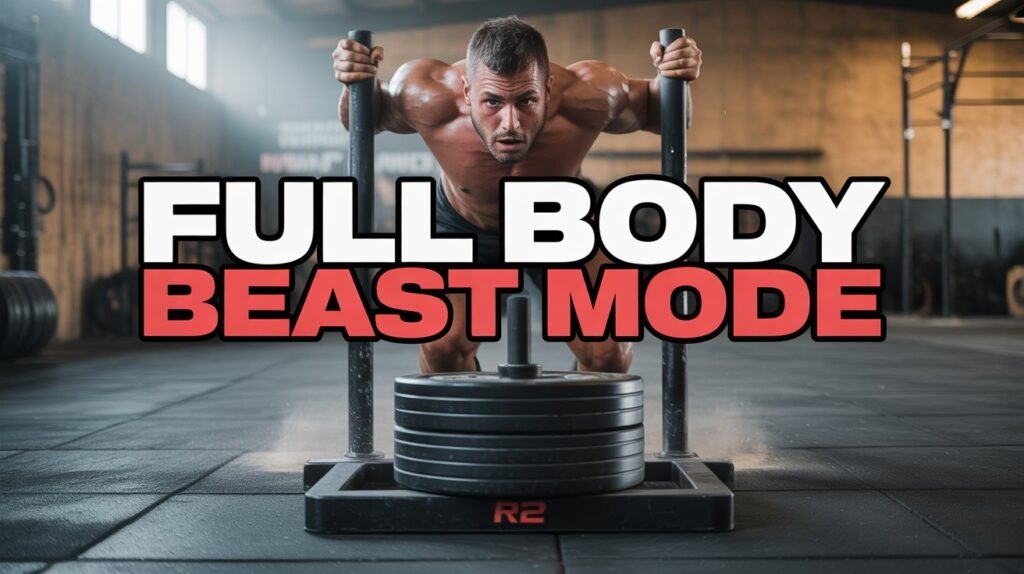
The Rage Fitness R2 Pull Sled is not just a piece of bent steel; it is a meticulously designed instrument intended to solve the most pervasive problems in the “grindset” of home fitness: space constraints, excessive noise, and the need for high-stability pulls. The unit features a compact architecture with dimensions measuring exactly 26.5 inches in length, 8 inches in width, and 16.5 inches in height. While some might think a sled this small is “delulu” for serious training, the material choice and weight distribution tell a different story. Constructed from high-tensile alloy steel, the sled itself maintains a base weight of approximately 10 to 15 pounds, allowing for extreme portability while maintaining the structural integrity required to handle a 90-pound plate load.
The “lore” of the R2’s stability lies in its single-post design. By utilizing a 2-inch diameter, 7-inch tall vertical pole centered on the sled’s longitudinal axis, Rage Fitness ensures that the center of mass remains low and perfectly aligned with the pull vector. This prevents the “wobble” or “fishtailing” often seen in dual-post sleds when the athlete’s gait is not perfectly symmetrical. For those looking to level up their home setup without the “clutter core” aesthetic of massive commercial equipment, the R2 offers a “snatched” footprint that fits under most power racks or in a standard car trunk.
Structural Integrity and Dimension Matrix
The following data represents the core physical properties of the R2 system, providing a technical baseline for further biomechanical analysis.
| Feature | Engineering Specification | Clinical/Athletic Benefit |
| Footprint (L x W x H) | 26.5″ x 8″ x 16.5″ | Space-saving, vertical storage compatible |
| Material Composition | Alloy Steel (High-Tensile) | Durable against turf and grass abrasion |
| Loading Mechanism | 2″ Diameter Single Post | Accommodates Olympic bumper plates |
| Post Height | 7 inches | Capacity for ~2-3 45lb bumpers or steel |
| Harness System | 6.5′ Straps with 6.5″ Padding | Ergonomic force distribution on shoulders |
| Weight Capacity | 90 lbs (Structural Limit) | Optimized for speed and recovery |
| Waist Harness Size | 29 inches | Secure fit for athletic builds |
While the 90-pound limit might seem “lowkey” compared to the 500-pound capacity of the Titan Power Drag, the R2 is designed for a specific “aura”—the aura of speed and joint longevity. The friction physics of a smaller sled means that 90 pounds on high-pile turf can generate a horizontal resistive force (Fr) that challenges even elite sprinters.
Biomechanics of the Backward Drag: Bulletproofing the Knees
In the current era of “mewing” for aesthetic jawlines and “looksmaxxing” for physiques, the real “flex” is having knees that don’t sound like a bowl of Rice Krispies. The R2 Pull Sled has gained a “sigma” status among followers of the “Knees Over Toes” philosophy because of its efficacy in the backward sled drag. The “problem” many face today is chronic knee pain stemming from an over-reliance on eccentric-heavy movements like squats without sufficient concentric-only development.
The R2 solves this “skill issue” by providing a movement that is entirely concentric. When you drag the sled backward, the muscles shorten under tension without the subsequent stretching phase that causes muscle damage (DOMS). This allows the athlete to “cook” their quads and glutes daily without feeling “washed” or “cooked” the next morning. The R2’s 6.5-foot straps allow for a 45-degree body lean, which is the “rizz” required to properly target the Vastus Medialis Oblique (VMO), the “teardrop” muscle essential for knee stability.
Friction Physics and Force Production
The relationship between the sled and the surface is governed by the coefficient of friction (μ). For the R2, the force required to maintain motion (Fk) is calculated as follows:
Fk=μk⋅N
Where N is the normal force (the sum of the sled’s weight and the loaded plates). On standard artificial turf, μk can vary between 0.35 and 0.55. The R2’s runners are polished to ensure that while the resistance is high, the “vibe” of the pull remains smooth.
| Surface Type | Estimated Friction (μ) | Resistance Feel (90lb Load) |
| Artificial Turf | 0.45 | Moderate – High (Sprint focus) |
| Short Grass | 0.55 | High (Strength focus) |
| Smooth Concrete | 0.25 | Low – Noisy (Speed focus) |
| Rubber Gym Flooring | 0.85+ | Extreme (Grind focus) |
This friction variability means the R2 is essentially a “shape-shifter.” If you find that 90 pounds is too light on a track, moving it to grass or rubber flooring immediately “yasifies” the difficulty level without needing more plates.
Solving the “Home Gym Lore”: Space, Noise, and Neighbors
One of the biggest “unhinged” behaviors in the home gym community is trying to use a commercial-grade prowler in a 1-car garage. The “brain rot” of buying equipment that doesn’t fit your space is real. The R2 Pull Sled serves as the “antidote” to this problem. Most users currently face three primary issues:
- The Space Tax: Large sleds take up precious square footage. The R2 is so compact it can be hung on a wall peg.
- The Noise Complaint: Metal sleds on concrete sound like a demon being exorcised. The R2 is designed for grass and turf, and its lighter base weight reduces the “scrape” decibels.
- The Setup Fatigue: If it takes 20 minutes to set up a sled, you’re not going to use it. The R2 is “plug and play”—just drop a plate on the single post and go.
The R2’s 6.5-inch straps are equipped with heavy-duty padding to prevent “chafing aura,” ensuring that the only thing hurting after your workout is your quads. This “user experience” focus is why the R2 has 91% of respondents recommending it to their friends—it doesn’t just work; it’s actually “lit” to use.
Comparative Market Positioning
To understand why the R2 is the “sigma” of the budget sled world, we must compare it to its peers in 2026.
| Product | Price (Estimated) | Weight Limit | “Vibe” / Best Use Case |
| Rage Fitness R2 | $95 – $110 | 90 lbs | Portable “Knees Over Toes” goat |
| Titan Power Drag | $97 | 500 lbs | Budget heavy-dragger (Bulky) |
| Spud Inc Magic Carpet | $114 | 600 lbs | Ultimate portability (Nylon fabric) |
| Rogue Echo Dog Sled | $255 | 450+ lbs | The “American Made” tank |
| Torque Tank M1 | $700+ | Magnetic | The “Silent but Deadly” rich kid choice |
The “tea” here is that while the Spud Inc Magic Carpet is more portable, it often “caps” out on performance because the nylon can bunch up or catch on uneven turf. The R2, being steel, gives you that “smooth pull” that keeps your momentum from being “cooked” mid-set.
Metabolic “Lore”: Sled Training for the Shred
For those in a “cutting” phase or trying to avoid “dad bod” energy, the R2 Pull Sled is a metabolic furnace. Pushing or pulling a sled with near-maximal effort is one of the few ways to perform “Neuro-Kinetic HIIT”—training your fast-twitch fibers without the “CNS burnout” associated with heavy barbell work.
The science suggests that sled pushes and pulls increase your VO2 max and “shred” body fat by creating a massive “oxygen debt”. Because the R2 allows you to “take off and add weight easily,” you can perform “Drop Sets” on the fly. Start with 90 lbs for a 20m drag, drop to 45 lbs for a 20m sprint, and finish with an empty sled for a high-knee burn. That’s “peak performance” in just 60 seconds.
To get the most out of these metabolic protocols, you’ll need a harness that doesn’t “gatekeep” your breathing.👉 The R2’s harness is specifically “yassified” for comfort, as seen in the specs here: 👈
Training Phases and Programming
A typical “let them cook” training cycle for the R2 involves three distinct phases designed to maximize its 90lb capacity.
- The Foundation (Weeks 1-2): High-volume backward walks. 10 sets of 30 meters at 45 lbs. Focus on “Ass to Grass” depth and joint lubrication.
- The Power Surge (Weeks 3-4): Heavy drags. 6 reps of 15 meters at 90 lbs. Rest 90 seconds. This is for the “gains”.
- The Speed Check (Weeks 5-6): Weighted sprints. 8 sets of 20 meters at 25 lbs. Max effort. This builds that “explosive rizz” on the track.
The “SLED” Market and Economic Reality
In the professional world, “SLED” also stands for State, Local, and Education markets, which are currently seeing a surge in equipment procurement for high school and collegiate weight rooms. The Rage Fitness R2 is perfectly positioned for this “close-out” fiscal cycle because it is “economically priced to fit your budget”. Athletic directors are realizing that instead of one $3,000 motorized treadmill, they can buy 30 R2 Pull Sleds and train the entire football team at once.
This “piggybacking” of consumer trends into the institutional market is “no cap” the reason Rage Fitness has stayed relevant. The R2 isn’t just a toy for “gym rats”—it’s a “certified” piece of conditioning hardware used in ACFT (Army Combat Fitness Test) training and professional athletic labs.
Institutional and Consumer Durability Ratings
| Stress Factor | R2 Rating (1-10) | Reasoning |
| Abrasive Wear | 8 | Thick steel runners hold up well on turf |
| Strap Strength | 9 | Nylon straps are double-stitched for high-tension pulls |
| Weather Resistance | 7 | Powder coating prevents rust, but don’t leave it in the “Ohio” rain |
| Ease of Assembly | 10 | Comes out of the box ready to “slay” |
Conclusion: The Final Fit Check
The Rage Fitness R2 Pull Sled is the ultimate “sigma” move for anyone tired of the “gatekeeping” in the high-end fitness world. It solves the “knee lore” problems with backward drags, defeats the “space tax” with its compact size, and offers “no cap” value for under a hundred bucks. Whether you’re recovering from an ACL “skill issue” or just want to “glow up” your conditioning, the R2 is the “GOAT” of portable resistance.
Don’t let your training be “mid”—grab the sled that’s actually “bussin” and start your journey to being “shredded” today. The path to “peak aura” starts with a single pull, 👉and the best place to find your gear is right here: . 👈