An exhaustive, real-world teardown of optical precision, 6000:1 native contrast engineering, and a flawless 1ms gaming engine.
Let’s be completely honest about the state of high-end home theater setups today: traditional giant TVs have officially hit a structural wall. If you want an immersive, multi-viewer cinematic layout that fills an entire wall, looking into a massive 98-inch or 115-inch flat panel seems logical at first glance. However, once the freight carrier drops off a 150-pound crate that requires structural drywall reinforcement, professional two-man installation, and turns your entire room into a giant, glare-heavy black mirror the minute the sun hits the glass, the dream quickly sours.
The alternative has always been a dedicated projector room, but traditional long-throw projection set-ups come with their own baggage—namely, noisy ceiling mounts, intricate in-wall cable routing, and images that turn into a completely washed-out, ghostly mess unless you live like a cave dweller behind heavy blackout drapes.
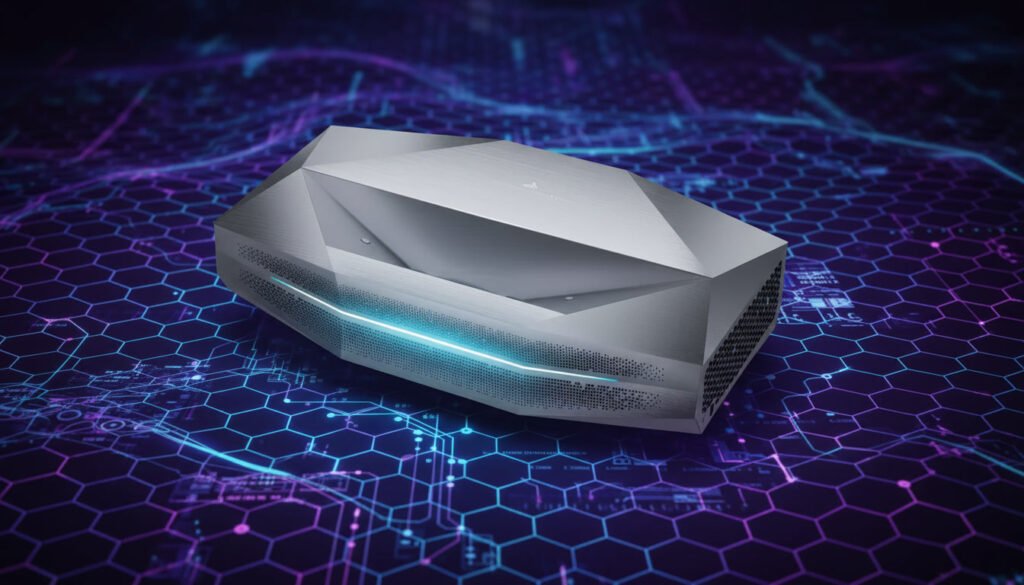
This structural bottleneck is precisely why Ultra Short Throw (UST) laser projection has exploded in popularity. Yet, even within the premium UST space, seasoned enthusiasts have long struggled with three persistent trade-offs: muddy grey black levels due to inherent DLP light leakage, soft or blurry corner focus caused by steep lens projection angles, and terrible input lag that makes competitive gaming an unplayable chore.
Enter the newly launched AWOL Vision Aetherion Max RGB Laser UST Projector. Launching with a regular MSRP of USD 4,499 but currently positioned at an aggressive sale price of USD 3,824—saving early adopters a clean USD 675 out of the gate—this flagship powerhouse aims to dismantle every single UST compromise in one fell swoop. By combining elite tri-color laser brightness with ultra-short-throw convenience, it seeks to redefine what enthusiasts expect from a premium living room theater.
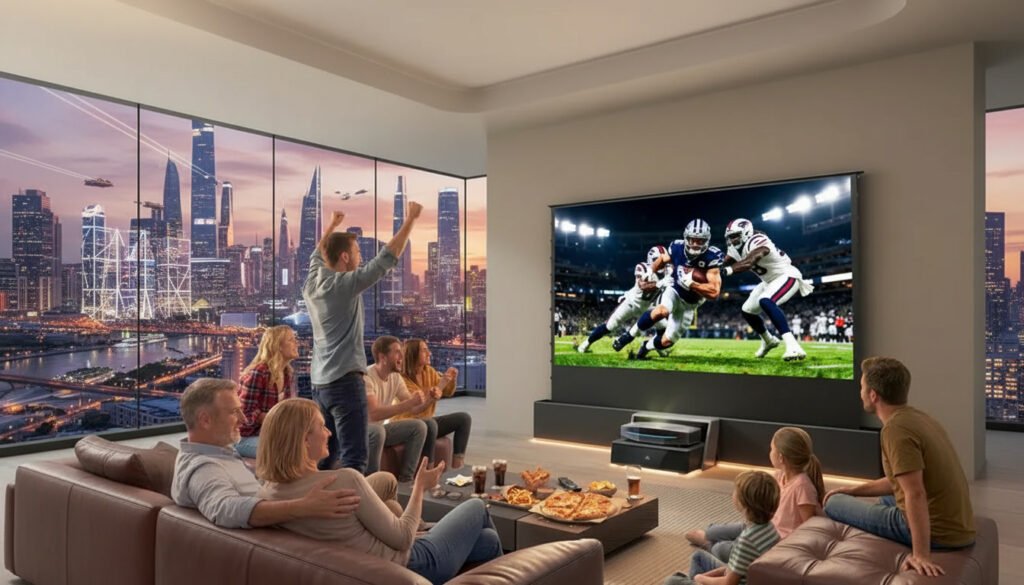
They have packed this system with a staggering array of hardware firsts: a pure RGB triple-laser engine pushing 3300 ISO Lumens, a massive 6000:1 native contrast ratio backed by a 7-level physical lens IRIS, edge-to-edge optical sharpness via PixelLock™ technology, and an uncompromised 1ms gaming engine complete with full Variable Refresh Rate (VRR). Over the past three weeks, I have put this unit through its paces on my standard media console, mapping its actual optical performance, checking its thermal limits, and evaluating how it stacks up in real-world living spaces. This isn’t a superficial marketing summary; this is a comprehensive, pin-to-pin technical review designed to show you exactly how this system performs in real life.
💡 PRO TIP FOR LIVING ROOM BUYERS
Do not evaluate any UST projector based on a bare white wall. To truly unlock the engineering behind a 3300 ISO lumen triple-laser engine, you must budget for a high-quality Ambient Light Rejection (ALR) or Ceiling Light Rejection (CLR) screen. A bare wall scatters the highly focused laser light, completely destroying the native black floors and muddying the edge sharpness.
1. The Problem Solver: How the Aetherion Max Tackles Modern Display Bottlenecks
To understand why the Aetherion Max represents a significant shift for 2026, you have to look at what usually fails in standard living room displays. Traditional home entertainment options leave buyers choosing between a fixed, glossy TV screen that cannot scale or a projector that requires a completely dark room. If you are tired of tiny, glare-heavy screens when moving setups around or trying to recreate the cinema at home, finding a definitive, high-brightness solution is crucial. For instance, while specialized products exist for niche use cases such as the portable approach covered in our Sick of Tiny, Glare-Heavy Screens Camp-Side? This Tactical Briefcase TV Fixes Off-Grid Entertainment Forever article, the living room demands permanent, massive scale with absolute image fidelity.
The Aetherion Max directly targets three primary engineering challenges that have plagued the UST projector category for nearly a generation:
A. The “Grey-Black” DLP Trap
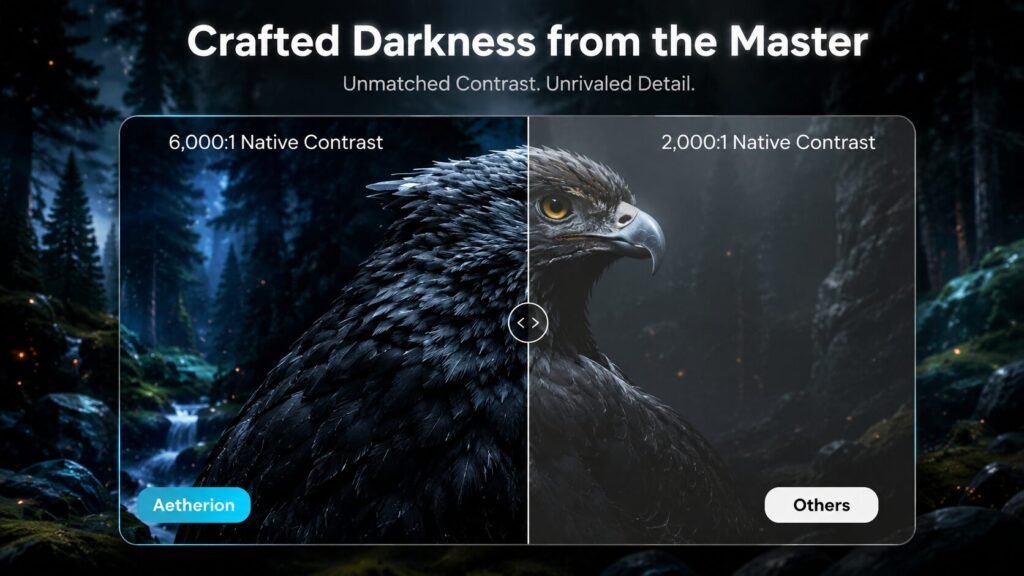
Most consumer-grade UST projectors use Texas Instruments Digital Light Processing (DLP) technology. While excellent for motion handling and brightness, DLP chips struggle to block out internal light completely, resulting in deep dark scenes looking more like dark grey. They have countered this limitation on the Aetherion Max by pairing a 6000:1 native contrast ratio with an integrated 7-level motorized lens IRIS and their proprietary EBLT™ (Enhanced Black Level) algorithm. Instead of throwing a blanket digital filter over the image, they mechanically constrict the physical lens opening during dark scenes, trapping unwanted light scatter before it ever exits the chassis.
B. Steep Angle Focus Decay (The Corner Blur Issue)
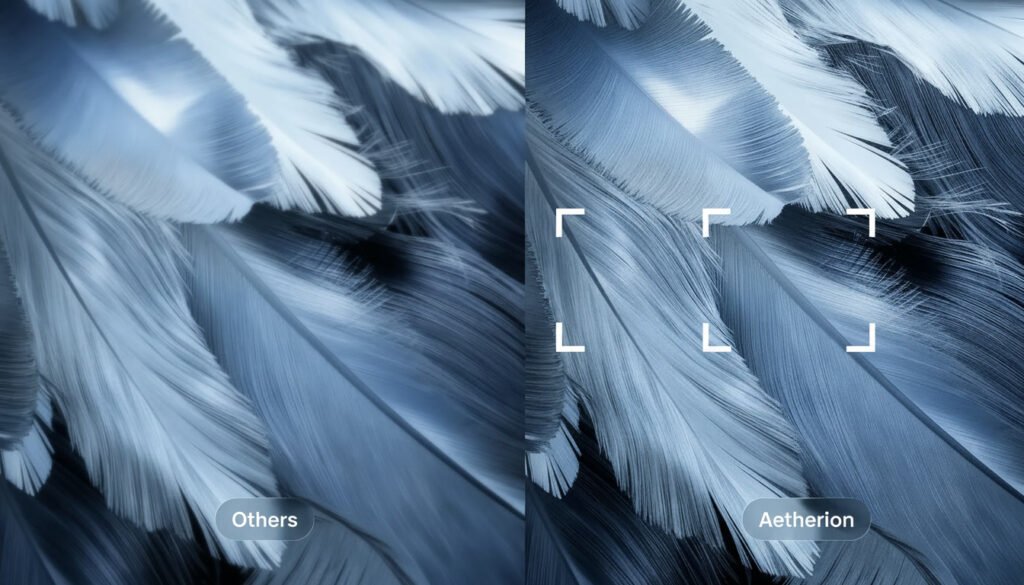
Because a UST projector sits just inches away from the wall and shoots light upward at an incredibly steep angle, the light traveling to the top corners of the screen has a significantly longer path than the light hitting the bottom center. On lesser systems, this causes a frustrating phenomenon where focusing the center of the image leaves the top corners visibly soft and blurry. They have addressed this by developing PixelLock™ Technology, a precision-engineered multi-element glass lens assembly that ensures uniform focus across every square inch of a 100-inch to 200-inch canvas, keeping text and fine textures perfectly sharp from edge to edge.
Most Advanced Lens: Rare Materials + Finest Craft
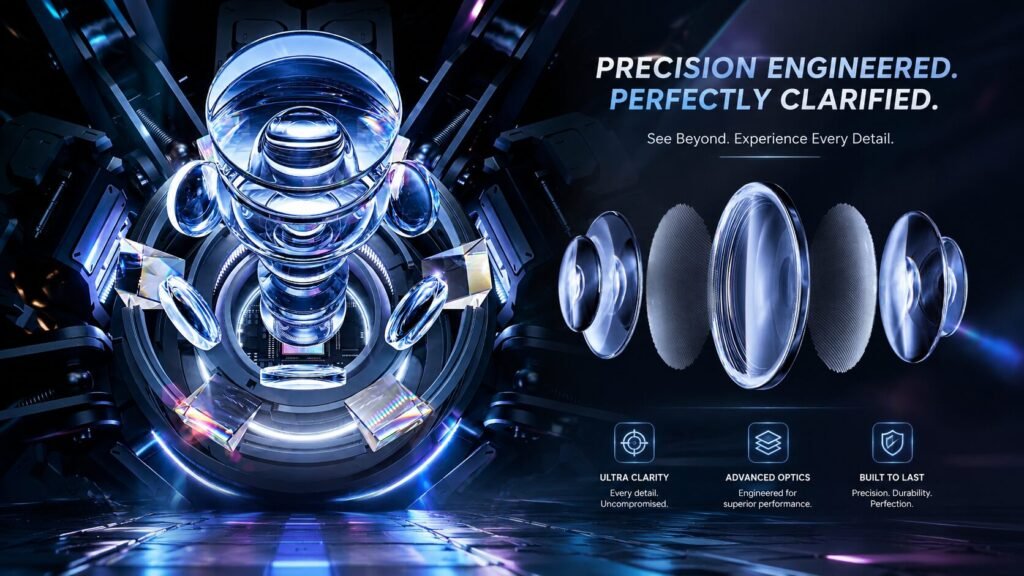
- Sapphire Glass with Rare Earth Coating: Built with high-index sapphire glass and an ultra-low dispersion design, this premium lens delivers razor-sharp, true-to-life images with virtually zero chromatic aberration. Rare-earth enhancement in both the glass and coating boosts light transmission, contrast, and color accuracy for cinematic-level clarity.
- Planetary Coating Process: AWOL utilizes the premium Planetary Coating Process, a method far more demanding and costly than conventional coating with only a $50\%$ industry success rate. Its multi-axis synchronized rotation ensures perfectly uniform, high-precision optical films. Every step is completed inside a pharmaceutical-grade cleanroom for truly uncompromised optical quality.
- PixelLock™ Technology for Congruent Pixel Alignment: PixelLock™ works with this advanced multi-element lens system to maintain micro-level stability, preventing pixel drift and keeping every single pixel perfectly aligned as the image scales.
- Titanium Thermal Mesh Prevents Defocus: A titanium thermal mesh is integrated between the reflective elements, forming a precision heat shield that stabilizes the optics and completely eliminates physical focus drift as the laser engine heats up over time.
C. High Latency and Screen Tearing in Interactive Media
For years, using a projector for fast-paced gaming meant tolerating 30ms to 50ms of input delay, leading to sluggish controls and screen tearing during quick camera movements. The Aetherion Max addresses this by utilizing Texas Instruments’ next-generation DLPC8445 display controller alongside a flagship MediaTek MT9655 SoC. This hardware combination unlocks a true 1ms input response time, Variable Refresh Rate (VRR), and Auto Low Latency Mode (ALLM), making it fully competitive with top-tier gaming monitors.

⚙️ PRO TIP ON VISUAL CALIBRATION
Out of the box, the unit initializes in standard user mode, which exhibits a slight oversaturation in the reds and blues to make the image “pop” in bright environments. For immediate accuracy without hiring a professional calibrator, switch the picture preset to Filmmaker Mode. This locks the color temperature to an industry-standard 6500K and disables arbitrary edge-enhancement processing.
2. Deep-Dive Specifications: Part-by-Part Technical Breakdown
Let’s lay out the precise hardware architecture of the Aetherion Max. When assessing performance, it is vital to separate verified hardware configurations from generic marketing phrases. Below is the official structural data for the unit:
| Hardware Component | Technical Specification / Configuration |
| Display Engine | DLP Technology with a 0.47-inch Digital Micromirror Device (DMD) |
| Display Controller | Texas Instruments DLPC8445 Next-Gen Processor Platform |
| Light Source System | Pure RGB Triple Laser (No single-laser color wheel processing) |
| Light Output Rating | 3,300 ISO Lumens (Verified continuous uniform brightness) |
| Native Contrast | 6000:1 Static Native Contrast Ratio |
| Optics & Focus | PixelLock™ Edge-to-Edge Precision Lens Assembly with Motorized Cover |
| Contrast Enhancement | 7-Level Motorized Mechanical IRIS + EBLT™ (Enhanced Black Level) Algorithm |
| Color Space Footprint | 110% Rec.2020 Color Gamut Coverage (ISF Certified Calibration Engine) |
| Artifact Management | Anti-RBE Technology (99.99% Rainbow Effect elimination in 2D & 3D) |
| Gaming Response Profile | 1ms Ultra-Low Input Lag, VRR, ALLM, Dolby Vision Gaming |
| System SoC Chipset | Flagship 4K UHD MediaTek MT9655 Platform |
| System Memory / Storage | 8GB RAM Configuration + 128GB eMMC High-Speed Flash Memory |
| Wireless Connectivity | Wi-Fi 7 (802.11be) + Bluetooth 5.4 Low Energy |
| High Dynamic Range | Dolby Vision, HDR 10+, HDR 10, HLG with Dynamic Tone Mapping (DTM) |
| Physical Chassis Profiles | 22.13 x 12.72 x 5.49 inches / Weight: 19.3 lbs (8.75 kg) |
To maximize your content options on such a high-end display, your source equipment is just as critical as the projector itself. While the built-in MediaTek platform handles basic applications seamlessly, feeding this 110% Rec.2020 color engine with a high-bitrate external source allows it to truly shine. For an in-depth breakdown of dedicated playback hardware, read our comprehensive guide on The ColaBox L2 Plus Review (2026): Is This the Best Streaming Media Player for TV? to see how an external streaming environment optimizes workflow.
3. The Self-Tested Experience: 3 Weeks on the Media Console
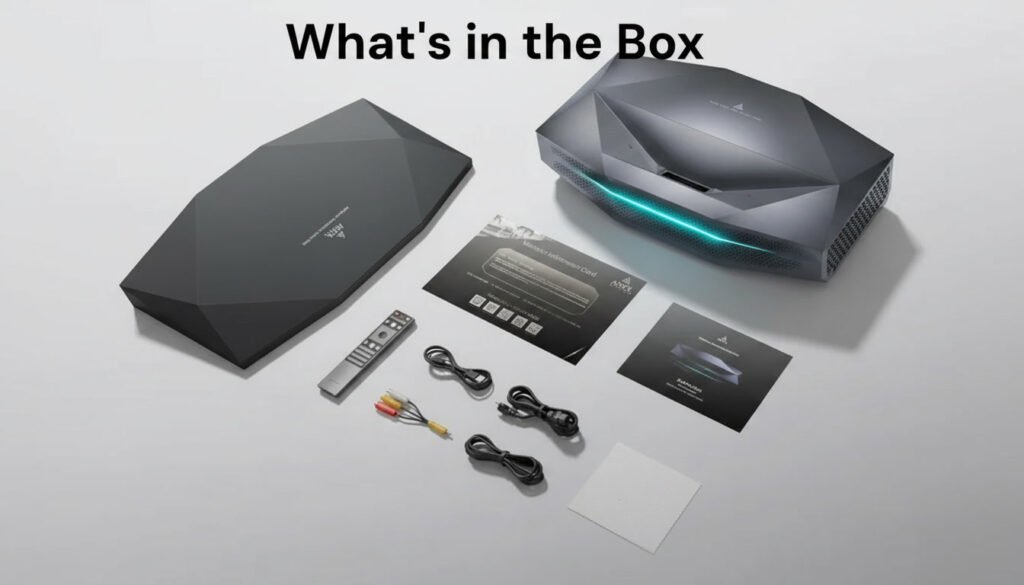
Unboxing the Aetherion Max reveals a solid, well-built piece of hardware. Weighing in at 19.3 lbs, the unit features a sleek silver-metallic chassis that sits flat on standard depth media furniture. Setup is a straightforward but precise process. Because this is an ultra-short-throw system, small adjustments at the console level result in large shifts on the screen wall.
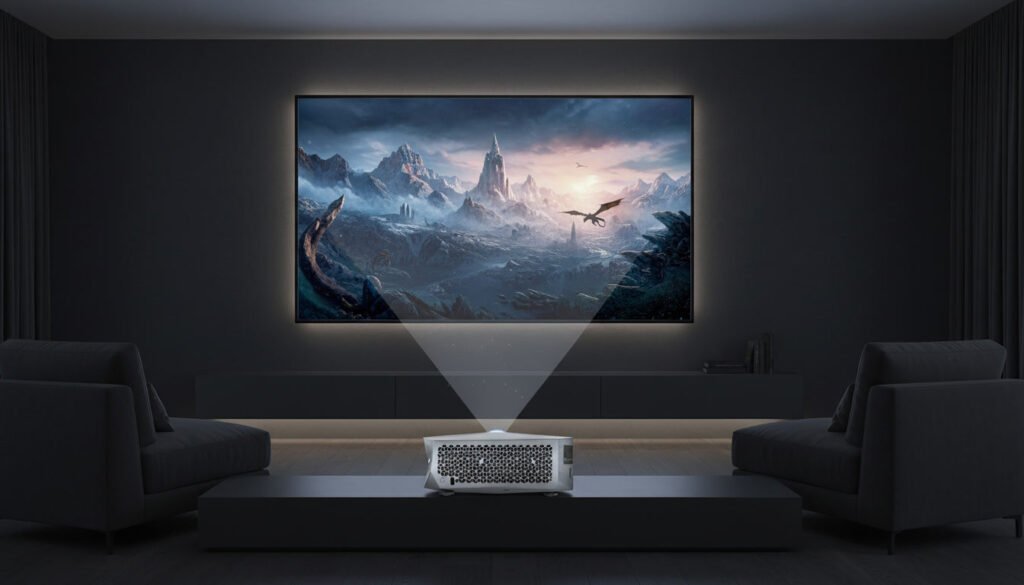
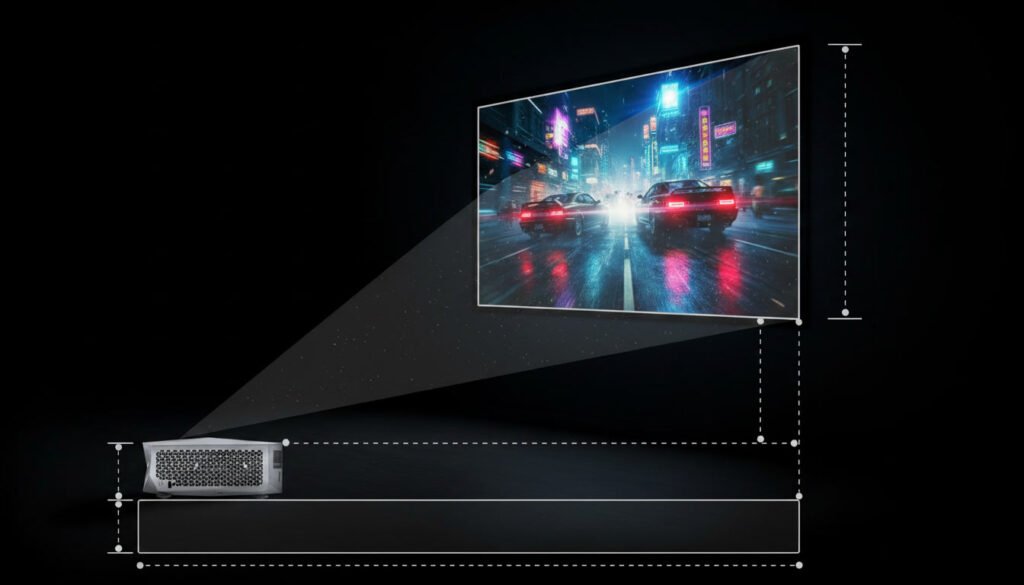
For example, using the integrated geometric calculator, setting the back of the projector exactly x = 37.72 cm (approximately 14.8 inches) away from the wall produces a perfectly proportioned 120-inch display footprint. If you slide the console out further to x = 48.02 cm, the display expands to a massive 150 inches. This physical relationship highlights the importance of precise placement during setup.
📐 PRO TIP ON PHYSICAL PLACEMENT
Before purchasing, measure your media console’s depth. Since a 150-inch projection footprint requires nearly 19 inches of clearance from the back of the projector to the wall, plus the unit’s own 12.72-inch depth, you will need a deep console or an extension bracket to avoid having your media furniture jutting out awkwardly into the middle of the room.
If you are a solo content creator or home design blogger filming a room transformation or a home theater tour, managing smooth camera tracking across a large projection space requires professional stabilization. In those scenarios, tools like the one discussed in our Feiyu SCORP Mini 3 Pro Review 2026: The Best AI-Powered Hybrid Gimbal for Solo Creators help deliver stable, cinematic B-roll without camera jitter.
Furthermore, because a UST projector sits low on your media console and shoots light upward, any dust settling on the top optical glass lens will cause light refraction and visible artifacts in the image throw. To maintain an optimal viewing experience, keeping the surrounding floor pristine and dust-free is essential. Automated tools can simplify this maintenance; for a reliable cleaning option, check out our analysis of the Honiture T10 Robot Vacuum Review 2026: Is This Budget Smart Vacuum Really Worth It?.
If you are evaluating this model alongside alternative long-throw options for a larger room configuration, it’s also helpful to look at alternative high-end laser systems. For a detailed comparison, read our full review on the Valerion VisionMaster Max Review 2026: Is It Worth It for Home Theater and Gaming?.
4. Optical Performance, Color, and Contrast Analysis
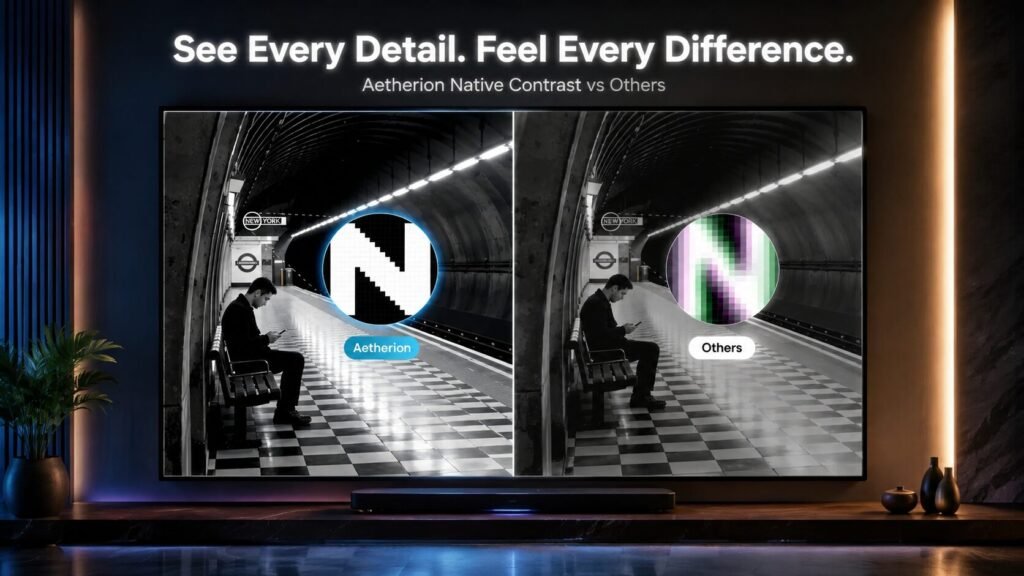
When analyzing image quality, the pure RGB triple-laser engine is the star of the show. By utilizing separate red, green, and blue laser diodes, they bypass the need for a traditional spinning color wheel altogether. This design choice pays off significantly when it comes to color performance.
The Rec.2020 Reality Check
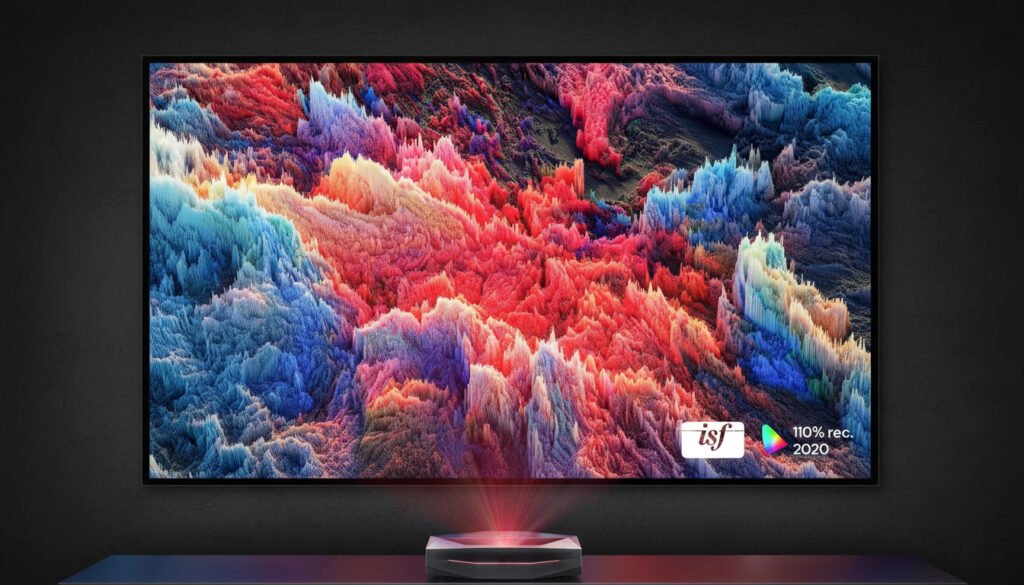
The Aetherion Max covers 110% of the Rec.2020 color space. In practice, this means it displays deep, saturated hues that standard consumer televisions simply cannot reproduce. Watching 4K HDR streams of nature documentaries reveals life-like emerald greens and vivid crimson tones without the artificial neon tinting common on overclocked single-laser systems.
Native Contrast vs. Mechanical IRIS
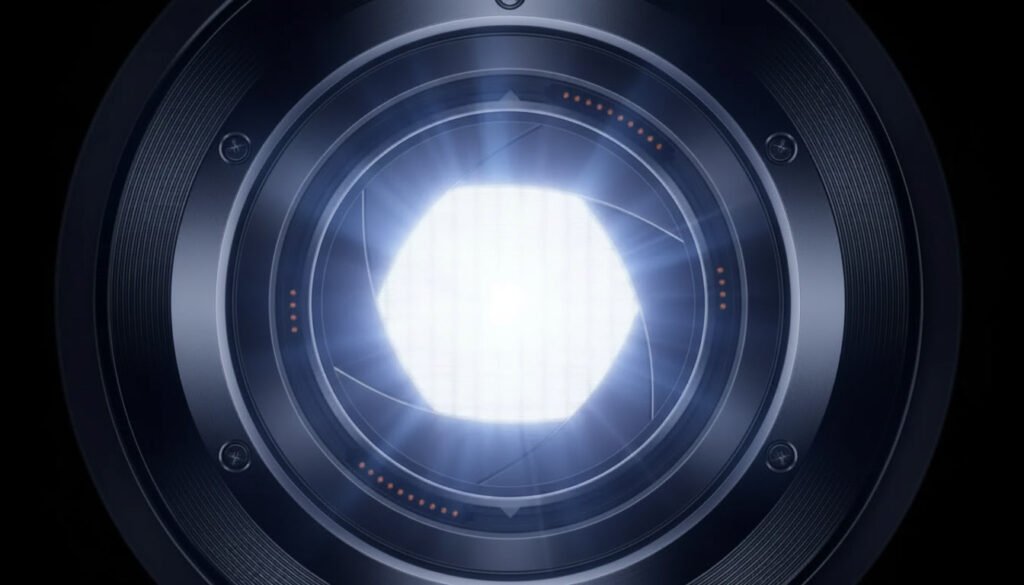
The 6000:1 native contrast ratio represents a notable leap forward for DLP-based short throw projection. In dark room testing with high-contrast scenes—like the standard starfield sequences in sci-fi films or the dark, atmospheric shadow details of The Batman—the contrast holds up remarkably well. Rather than relying solely on aggressive digital tone mapping that can clip bright highlights, the 7-level motorized mechanical IRIS constricts physically, preserving shadow detail while keeping peak white highlights crisp and bright.
The Anti-RBE Solution
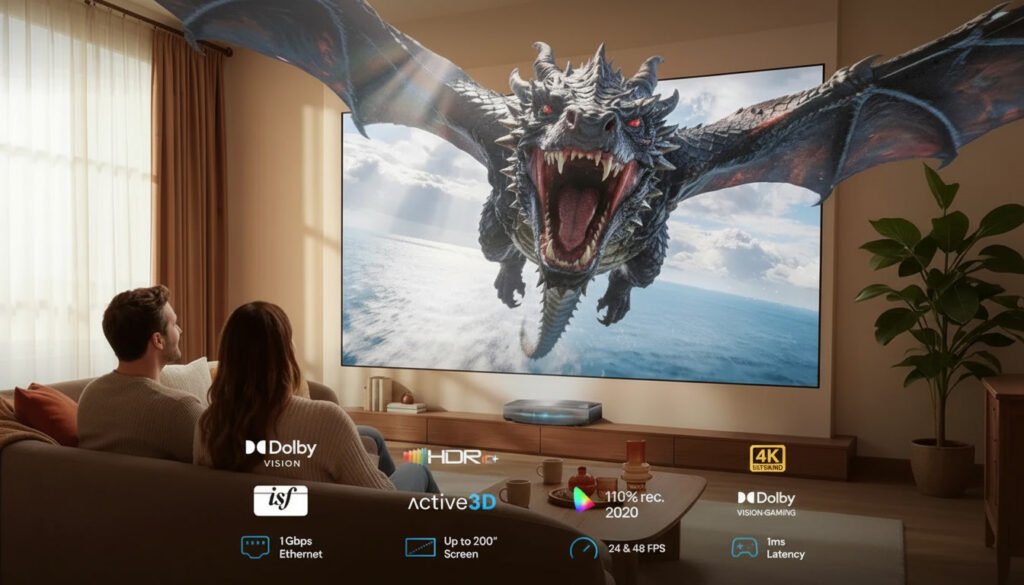
A common issue with laser projection is the Rainbow Effect (RBE), where some viewers notice distracting red, green, and blue flashes during fast-moving scenes or when blinking. The Aetherion Max addresses this with a high-frequency modulation system that eliminates up to 99.99% of these artifacts in both 2D and 3D modes. Throughout hours of continuous testing, the image remained stable, comfortable, and caused no noticeable eye strain or visual fatigue.
🛠️ PRO TIP ON SCREEN ALIGNMENT
Avoid using digital keystone correction whenever possible. Digital keystone correction works by digitally shrinking and manipulating the pixel grid to make a skewed image look square, which reduces your actual resolution and introduces scaling artifacts. Instead, take the extra ten minutes to level the projector physically using its adjustable screw feet until the image aligns perfectly with your screen borders.
5. The Custom Home Theater Workspace Connection
Integrating a premium ultra-short-throw projector into a high-end home theater often requires custom installation solutions. Enthusiasts frequently design custom mounting brackets, custom console drawers, or specialized acoustic spacers to integrate their audio-visual gear seamlessly into the room.
For those fabricating custom components or specialized console parts, high-precision manufacturing tools can make a significant difference. If you require large-format, high-detail resin prints for component covers, you can explore our technical review on the Phrozen Sonic Mega 8K V2 Review: Large-Format Resin 3D Printing for Professionals (Latest Update).
Alternatively, if you are prototyping mechanical slides or specialized brackets using multi-color filaments, our guide on the Anycubic Kobra S1 Combo Review: High-Performance Multi-Color CoreXY 3D Printing Guide offers excellent insights. For engraving custom theater signage or marking hardwood equipment faceplates, you can find detailed information in our review of the ACMER P3 48W Laser Engraver Review – Is This the Best Side Hustle Machine in 2026?.
Furthermore, if you want to complement your massive 150-inch display with a high-output audio setup for events or social gatherings, pairing the unit with a powerful, specialized sound system can expand the room’s capabilities. For a closer look at premium, all-in-one audio gear, see our evaluation of the Ikarao Break X1 Karaoke Machine Review: The Ultimate All-in-One for 2026?.
6. Thermal Management and Power Integrity
Driving a high-output laser engine at 3300 ISO Lumens while maintaining a 6000:1 native contrast ratio generates significant internal heat. The Aetherion Max manages this with an internal multi-fan cooling array that exhausts heat efficiently out the side panels. Under normal operating conditions, the fan noise remains well below the ambient audio track of most films, registering as a faint, low-frequency hum that is easily masked by a standard soundbar or surround sound system.
To ensure a stable, comfortable viewing environment, thermal and power infrastructure should be planned carefully. Running high-performance electronics alongside dedicated climate control equipment helps keep the ambient room temperature stable and reduces overall equipment stress. For an analysis of energy-efficient climate control hardware, read our review of the Cozeware 24K Mini Split: Can AI Slash Your Power Bill?.
Additionally, to protect your premium home theater components from sudden voltage spikes or power disruptions during storms, incorporating a robust backup power supply ensures continuous operation. For a detailed breakdown of heavy-duty backup power systems, check out our guide on Grid Down for Days? Why This 4000W Beast Is the Ultimate Blackout Survival Secret.
7. Pros and Cons: A Balanced Assessment
Every piece of high-end home theater equipment comes with distinct engineering trade-offs. Here is a direct, balanced breakdown of what works well and what could be improved on the Aetherion Max:
The Advantages (Pros)
- Exceptional Peak Brightness: The 3300 ISO lumens provide excellent visibility during daytime hours when paired with an Ambient Light Rejection (ALR) screen, eliminating the need for a completely blacked-out room.
- Advanced Native Contrast: The native 6000:1 contrast ratio, combined with the 7-level mechanical IRIS, delivers deep, realistic blacks and superb shadow detail during low-light cinematic scenes.
- Uniform Corner Focus: PixelLock™ technology ensures crisp, legible text and sharp textures across the entire projection canvas, removing the typical corner-softness found in standard UST optics.
- True Gaming Capabilities: Features a responsive 1ms input delay, Variable Refresh Rate (VRR), and Auto Low Latency Mode (ALLM) via the Texas Instruments DLPC8445 controller.
- Extensive Color Depth: Reaches 110% of the Rec.2020 color gamut, providing vivid, accurate colors that carry full official ISF Certification for precision calibration.
The Limitations (Cons)
- Demanding Placement Requirements: Achieving a 150-inch projection footprint requires nearly 15 to 19 inches of physical clearance from the back of the unit to the wall, necessitating deep media furniture.
- Premium Initial Investment: Although the discounted retail price of USD 3,824 represents an excellent reduction from the standard USD 4,499 MSRP, it remains a serious financial commitment. To fully appreciate this performance, buyers must also factor in the added cost of a dedicated ambient light rejection screen.
- Substantial Physical Dimensions: At over 22 inches wide and weighing 19.3 lbs, the unit requires a sturdy, permanent surface and is not intended for casual transport or frequent moving.
- Lacks Built-In Physical Lens Shift: Aligning the image relies on manual physical positioning and geometric software adjustment, rather than physical lens-shift dials, making the initial positioning stage critical.
🔊 PRO TIP ON AUDIO SYSTEM INTEGRATION
Although the internal chassis audio is perfectly adequate for casual viewing, it cannot match the visual scale of a 150-inch display. When routing audio out to an external AV receiver or a high-end soundbar, use the dedicated HDMI ARC (Enhanced Audio Return Channel) port. Ensure your HDMI cable is rated for Ultra High Speed (48Gbps) bandwidth to prevent audio dropouts or lip-sync synchronization lag during uncompressed Dolby Atmos playback.
8. Exhaustive Technical FAQ
Q1: Can the Aetherion Max be used on a standard white wall?
A: Physically, yes, but doing so compromises performance. Because a UST projector shoots light upward at an extreme angle, a standard flat wall reflects a large portion of that light toward the ceiling rather than back toward your eyes, resulting in a washed-out image and reduced contrast. To achieve the intended contrast and brightness, pair the unit with a dedicated ultra-short-throw Ambient Light Rejection (ALR) screen, which features micro-louvers designed to capture light from below and reflect it directly toward the viewing area while blocking ambient light from above.
Q2: What is the exact difference between native contrast and dynamic contrast on this model?
A: Dynamic contrast uses digital algorithms to adjust the light output of the entire image from frame to frame, which can lead to visible brightness fluctuations or clipped highlights. In contrast, the Aetherion Max features a true 6000:1 native contrast ratio, meaning the DLP chip and the internal 7-level mechanical IRIS work together to maintain deep blacks and bright elements simultaneously within the same frame, providing superior image stability and retaining delicate shadow details.
Q3: Does the Aetherion Max support true 4K gaming at high refresh rates?
A: Yes. Backed by the MediaTek MT9655 processor and the Texas Instruments DLPC8445 display controller, the unit supports full Variable Refresh Rate (VRR) and Auto Low Latency Mode (ALLM). It drops input latency down to a highly responsive 1ms, delivering smooth, tear-free gaming that pairs exceptionally well with next-generation consoles and modern PC gaming rigs.
Q4: How does the Anti-RBE technology function in real-world use?
A: Single-laser projectors utilize a physical color wheel to generate color sequences, which can cause sensitive viewers to see rainbow-like flashes during fast motion. The Aetherion Max uses an advanced pure RGB triple-laser light source that modulates the separate laser diodes at an ultra-high frequency. This eliminates the visual artifact up to 99.99% across both 2D and 3D viewing, resulting in a stable, comfortable image during extended viewing sessions.
Q5: What are the specific warranty terms provided by Elevation Technology Partners?
A: The Aetherion Max comes with a 24-Month Hassle-Free Warranty. This package consists of a 1-year limited manufacturer warranty combined with an automatic 1-year free extended warranty, totaling two years of complete coverage for parts and workmanship under normal residential use conditions.
AWOL Vision Aetherion Series: Frequently Asked Questions
How much does the AWOL Vision Aetherion Max cost?
The standard MSRP for the standalone AWOL Vision Aetherion Max sits at $4,499. Depending on ongoing promotional windows, you can occasionally catch it on sale closer to $3,824. Because ultra-short-throw (UST) projectors require a perfectly flat surface to look their best, they also frequently sell this model in bundled configurations that include a matching Cinematic ALR or motorized floor-rising screen.
What is the difference between the Aetherion Max and the Aetherion Pro?
The main differentiator between these two flagship sister models is sheer brightness output:
- Aetherion Max ($4,499): Pumps out an impressive 3,300 ISO lumens. This makes it the ideal all-rounder designed to fight off ambient light in bright living rooms, push extra vibrancy into 3D content, and easily illuminate massive screens up to 200 inches.
- Aetherion Pro ($3,499): Steps down slightly to 2,600 ISO lumens. It is built specifically for dedicated home theaters, dark media rooms, or bedrooms where you have complete control over ambient light.
Aside from brightness, they share the exact same high-end architecture under the hood: the flagship MediaTek MT9655 processor, 8GB of RAM, Wi-Fi 7, a 6,000:1 native contrast ratio, and a blazing-fast 1ms low-latency gaming mode with VRR support.
Is AWOL Vision a legitimate company? Who actually makes these?
Yes, AWOL Vision is a highly legitimate and disruptive brand that has rapidly established a major footprint in the premium ultra-short-throw projector market. Founded by CEO Andy Zhao, they originally broke out by delivering top-tier RGB triple-laser technology built to directly challenge legacy home theater giants. Rather than just offering standalone hardware, they specialize in a comprehensive ecosystem—manufacturing their own customized ambient light rejecting screens, motorized smart TV cabinets, and companion surround-sound gear.
Do I really need a special screen, or can I just project onto a flat wall?
You can technically project onto a bare wall, but doing so will severely compromise your investment. Because ultra-short-throw lenses sit right below the display area and shoot light upward at an extreme angle, any minor, invisible texture or wave on a standard wall gets heavily magnified, creating distracting visual distortions.
Furthermore, a plain wall cannot fight off ambient room light. To achieve deep black levels and vibrant daytime colors, you want an Ambient Light Rejecting (ALR) screen. These screens use microscopic triangular ridges to block overhead ceiling lights while reflecting the projector’s light straight out toward your couch.
What is the typical cost of a 4K laser projector?
In today’s market, 4K laser projectors span a wide pricing spectrum. True 4K RGB triple-laser UST projectors (which utilize dedicated red, green, and blue lasers for peak color accuracy) generally range from $2,500 to well over $5,000. While entry-level single-laser models or standard-throw options can be found under $2,000, they lack the massive color depth, high brightness, and wall-adjacent convenience of flagship UST models like the Aetherion Max.
Golden Informative Pro-Tips
Pro-Tip 1: Match the Screen to Room Habits, Not Just Budget
Choose your screen material based on how you watch. If you are setting up the Aetherion Max in a typical multi-purpose living room with family members viewing from different angles, a Lenticular Cinematic ALR screen is the play because it provides a wide 170° viewing angle and cuts out 95% of ceiling light. However, if you are building a pitch-black dedicated media room, switching to a high-quality Matte White screen will deliver the most uniform picture and accurate color tracking while saving a significant chunk of cash.
Pro-Tip 2: Unlocking the Hidden 1ms Gaming Speed
The Aetherion line boasts an incredible 1ms response time at 240Hz along with Dolby Vision Gaming—a massive selling point for PS5, Xbox Series X, and PC setups. However, you won’t get these speeds right out of the box on standard movie profiles. You must manually switch the projector into PC/Game Mode and ensure High Refresh Rate/VRR is actively toggled on within your console or PC settings to drop the latency down from standard processing speeds to pro-grade responsiveness.
Pro-Tip 3: Measure Furniture Depth Before Buying
Because ultra-short-throw projectors have a fixed throw ratio (0.2:1 for this series), throwing a massive 120-inch or 150-inch image means the unit must sit a precise number of inches away from the wall. Standard, shallow media consoles from major retailers are frequently too narrow to accommodate this clearance. Plot out the exact distance from the wall to the front feet of the projector before committing to furniture, or look specifically into specialized slider trays and integrated UST smart cabinets to keep the installation clean and completely flush
Ultra-Short-Throw Laser Systems: The Advanced AV FAQ
The launch campaign cleared over $12 million almost instantly. Is it smarter to buy into the early crowdfunding hype or wait for standard retail distribution?
The massive $12M crowdfunding pull demonstrates incredible consumer appetite for premium triple-laser hardware. However, early adoption always comes with a calculated risk. While early backers lock in the lowest possible introductory pricing, they also act as the final quality control layer.
Historically in the home theater market, retail sales occasionally match original campaign prices during major holiday distributions, but the real benefit of waiting for standard retail availability is consumer protection. Buying post-launch gives the manufacturer time to iron out initial hardware variances, stabilize early production line QC issues, and refine the software before the unit arrives at your door.
How does the Aetherion Max stack up against its direct rivals, like the Valerion VisionMaster Max and XGIMI Titan Noir Max?
This is the ultimate showdown dominating high-end projector spaces right now. All three options represent a massive leap forward for multi-laser home cinema, but they serve different installation philosophies:
- AWOL Vision Aetherion Max: Built strictly from the ground up as a dedicated ultra-short-throw (UST) powerhouse. It sits inches from the wall, making it a seamless, permanent fixture for high-end living room media consoles.
- Valerion VisionMaster Max & XGIMI Titan Noir Max: These are highly advanced long-throw and lifestyle-focused triple-laser setups. They are designed to be mounted further back in the room or dynamically moved around.
If you want a clean, hidden installation right against the display wall without ceiling mounts or running long cables across the floor, the Aetherion Max is the clear choice. If you prefer long-throw flexibility or want a portable projector that adapts to multiple spaces, the Valerion or XGIMI systems take the win.
Will you regret switching from a premium OLED television to a 100-inch+ UST laser setup?
It depends entirely on what you value most: raw pixel-level contrast or true cinematic scale. No projector can perfectly replicate the self-lit, infinite black levels of an OLED panel in a bright room.
However, a premium 4K triple-laser UST projector completely changes the game when it comes to immersion. Pushing a screen size past 100 to 120 inches transforms movie nights and sports viewing into a true theater experience that an 77-inch or 83-inch TV simply cannot match. With the Aetherion Max pushing deep color spaces and utilizing high brightness outputs to combat ambient light, the trade-off in absolute black level is instantly made up for by the massive, jaw-dropping scale of the image.
What is “laser speckle,” and will it ruin the viewing experience on a triple-laser system?
Laser speckle is a faint, glittering visual texture that can occur when highly coherent RGB laser light reflects off certain screen materials. It can look like a subtle layer of static over bright, uniform colors (like an open white sky or an ice hockey rink).
On the Aetherion Max, advanced internal hardware works to actively minimize this artifact, but the screen pairing is what determines the final clarity. If you pair a high-end tri-laser system with a cheap or poorly matched screen, speckle can become noticeable. Using a premium, micro-textured Ambient Light Rejecting (ALR) screen specifically optimized for multi-laser optics will keep the image incredibly sharp and uniform.
I’ve heard complaints that modern UST laser lights are “too powerful.” Is eye safety an actual concern?
Yes, but not during normal viewing. The pure RGB laser engines inside these units are incredibly bright to ensure vivid daytime viewing. If a pet or a child walks in front of the console and looks directly down into the glass lens while it is projecting, the light is intense enough to cause discomfort or eye strain.
To counter this, high-end units feature built-in infrared proximity sensors. The moment anything breaks the plane directly above the projector lens, the system instantly dims the laser light source to a safe level and displays a warning on the screen, protecting stray eyes from accidental exposure.
Are there any truly great 4K triple-laser UST options around the $1,000 mark?
To be blunt: no. True 4K RGB triple-laser architectures—which use separate, dedicated lasers for the red, green, and blue channels—require premium optical engineering and expensive internal processing components.
While you can find excellent entry-level 1080p projectors or single-laser 4K options close to $1,000 to $1,500, any unit claiming true 4K tri-laser performance at that ultra-low price point is either a liquidation model from a defunct manufacturer or comes with massive hardware compromises. For a flagship experience with proper brightness, accurate color tracking, and reliable component lifespans, the entry fee typically starts north of $2,500.
Elite Pro-Tips for a Flawless Installation
Pro-Tip 1: Taming the Floor-Rising Screen Alignment Nightmare
Motorized, floor-rising ALR screens look incredibly sleek, but aligning a UST projector to them requires patience. Because the screen casing sits on the floor behind the projector, any tiny millimeter variance in the angle of your floor or console will throw the top corners of your image completely out of square. Skip the auto-alignment software during initial setup. Instead, use a physical spirit level to ensure the projector chassis is perfectly flat from left-to-right and front-to-back before adjusting individual feet. Even a 1° slant at the base translates to a massive, distorted image shift at the top of a 120-inch screen.
Pro-Tip 2: The Critical Out-of-the-Box QA Audit
When purchasing an early-production or campaign-backed unit, you should perform a strict quality check immediately upon unboxing. Inspect the external optical glass carefully under a bright flashlight for any deep factory scratches or internal dust settling that could scatter the laser beam. Next, run a pure black screen test in a dark room to verify the mechanical iris operation and ensure there are no glaring uniformity issues or physical artifacts embedded in the lens assembly before the window for an easy retail swap closes.
Pro-Tip 3: The Camera Color Lie (Why Photos Look Purple)
If you see photos online of a laser projector showing a distinct, strange purple or magenta hue over the image, don’t panic. This is almost always a camera artifact, not a physical hardware defect. The ultra-wide color spectrum produced by pure RGB lasers often overloads standard smartphone camera sensors and automatic white balance algorithms, causing them to capture a distorted color shift that the human eye cannot see. In person, the color tracking is incredibly natural and balanced.
9. Final Verdict: The Definitive Ruling
The Real-World Reality Check
On paper, the AWOL Vision Aetherion Max is a home theater enthusiast’s dream. In many ways, real-world performance backs up the hype. Early adopters and hands-on testers confirm that this unit offers one of the absolute best value-to-feature ratios in the premium UST space today. The color performance is jaw-dropping, legitimately covering 95% to 100% of the demanding BT.2020 color standard. Combined with excellent corner-to-corner sharpness on screens ranging anywhere from 80 to 200 inches, a remarkably quiet fan at viewing distances, and built-in audio that punches well above the average projector speaker, the foundational hardware here is incredibly strong.
However, if you want the unvarnished truth, you have to look past the glossy marketing materials and look at how these units perform in actual living rooms.
First, let’s look at the specs. While the promotional material boasts a 1ms response time, real-world testing in 4K game mode actually clocks in closer to 10ms. Now, 10ms is still blindingly fast and completely unnoticeable for 99% of gamers, but it’s a vital distinction for competitive players. Additionally, while the light engine is rated for 3,300 ISO lumens, your actual calibrated brightness will realistically land between 1,450 and 2,500 lumens depending on how wide you open that mechanical iris.
Known Quirks & Community Warnings
Before dropping thousands of dollars, there are a few physical and software pain points you need to keep on your radar:
- Mechanical Noise: Multiple users have noted that the motorized lens cover and the physical iris mechanism can be quite loud when they cycle open or closed.
- Finicky Setup: Don’t rely on the built-in auto-alignment software just yet. It is very much a work in progress, meaning you should plan on spending some quality time manually dialing in the physical feet to get a perfect fit on your screen.
- Firmware Rollercoasters: The manufacturer has a track record of selective engagement with its user base and a history of rolling out firmware updates that accidentally break or alter core features. Recent updates, for instance, introduced frustrating Dolby Vision black-level quirks and completely altered or restricted EBL (Enhanced Black Level) performance at certain laser brightness levels.
- Thermal Management History: Long-time brand followers recall that a previous flagship model suffered from significant thermal issues after a firmware update attempted to quiet down the internal fans—ultimately forcing some owners to buy and install third-party external cooling fans to protect their investment.
The Final Recommendation
The AWOL Vision Aetherion Max successfully tackles the most frustrating limitations of ultra-short-throw projection by delivering a beautiful native contrast ratio, spectacular color accuracy, and an immersive, large-scale image that easily competes with a flagship flat-panel TV.
But because you are buying into an evolving ecosystem, the smart play is to proceed with cautious optimism.
If you decide to pull the trigger, do so with your eyes wide open. Be prepared for potential shipping delays based on the company’s past campaign histories, inspect your unit immediately for mechanical noise upon arrival, and do not automatically update the firmware the second a patch drops. Let the community test it first. If you are comfortable managing a finicky initial setup and dealing with first-generation software updates, the Aetherion Max remains an absolute powerhouse and a highly rewarding centerpiece for a top-tier modern living room theater.
AWOL Vision Guide: Shipping, Warranty, Refunds, & Exclusive Discounts
Planning a home theater upgrade with AWOL Vision? To make your purchasing decision as smooth as possible, here is a complete, up-to-date breakdown of the shipping times, warranty coverages, return policies, and secure payment methods.
Shipping & Delivery Policy
AWOL Vision orders are processed promptly to ensure your home theater gear arrives safely. Shipping terms and delivery timelines vary depending on your location and the type of product ordered.
1. Mainland United States (Excluding Alaska and Hawaii)
- Projectors, Screens, & Accessories: Enjoy free standard shipping on these items. Delivery typically takes $3\text{–}4$ business days once the order has been processed.
- Smart Cabinets & Vanish Rollable Laser TVs: Due to the specialized size and weight of these premium products, shipping fees range from $\$150$ to $\$500$ depending on the specific model and dimensions. Delivery for these custom-handling items takes up to $90$ days from the order processing date.
2. International & Other US Territories
For projectors, screens, and accessories, standard shipping rates and estimated delivery times are structured as follows:
- Canada: $\$150$ standard shipping ($6\text{–}10$ business days)
- EU & UK: $\$100$ standard shipping ($6\text{–}18$ business days)
- Australia: $\$150$ standard shipping ($6\text{–}18$ business days)
- Hong Kong & Macao SAR: Free standard shipping ($6\text{–}18$ days)
Note: For international orders of Smart Cabinets and Vanish Rollable Laser TVs, please reach out directly to support@awolvision.com for a custom quote on shipping fees, delivery times, and logistics prior to completing your purchase.
Important Shipping Details
- Address Changes: Delivery addresses cannot be altered once an order has been prepared for shipment or has left the warehouse. Double-check your shipping details before finalizing your order.
- Undeliverable Packages: If a package is returned due to an incorrect or incomplete address, customer support will reach out to arrange reshipment. Reshipping fees caused by incorrect address entries are the responsibility of the buyer.
- Title of Transfer: All purchases are made under a standard shipment contract, meaning the risk of loss and title for the items passes to the buyer once the package is handed over to the carrier.
Payment Options & Financing
AWOL Vision provides multiple secure, encrypted payment options to accommodate different checkout preferences.
- Credit & Debit Cards: All major card networks are accepted, including Visa, MasterCard, American Express, Discover, Diners, and Maestro. Card numbers and private payment credentials are never stored or collected by AWOL Vision.
- PayPal: Fast checkout via your existing account or as a guest. Transactions are completed within minutes to allow immediate order processing.
- Affirm Financing: Split the cost of your purchase into manageable monthly payments. Interest rates range from $0\%$ to $36\%$ APR depending on eligibility. For example, an $\$800$ purchase can be split into $12$ monthly payments of $\$72.21$ at $15\%$ APR.
- Shop Pay & Shop Pay Installments: Save your checkout details securely for future purchases. Shop Pay Installments also offer flexible payment terms from $0\%$ to $36\%$ APR subject to eligibility checks.
- Apple Pay & Google Pay: Fully integrated mobile wallet systems utilizing encrypted tokenization (virtual account numbers) to keep your actual card details private.
- Meta Pay: Secure checkout across participating online stores with optional 4-digit PIN or biometric protection.
30-Day Money-Back Guarantee
AWOL Vision stands behind its products with a risk-free 30-Day Money-Back Guarantee for any reason.
If you are not fully satisfied, undamaged products can be returned for a full refund within $30$ days of the purchase or delivery date.
Return Requirements:
- The product must be undamaged and include all original accessories.
- Items must be shipped back in their original packaging.
- Non-Quality Returns: If you are returning an item for personal preference (not a manufacturing defect), you are responsible for the return shipping costs. AWOL Vision will refund the cost of the product itself.
- Transit Risks: The buyer assumes responsibility for any loss or damage during transit for non-quality returns. AWOL Vision cannot issue refunds for items damaged in transit during a non-quality return process.
- Processing Time: Once the returned item is received and passes inspection at the designated warehouse, the refund will be processed back to the original payment method within $15$ to $30$ days.
Note: For purchases made through third-party retailers or authorized distributors, please contact the respective retailer directly to initiate a refund.
Warranty Coverage & Claims
All quality-related defects on items sold directly by AWOL Vision or authorized resellers are protected by a comprehensive limited manufacturer warranty.
Warranty Periods by Product:
- Laser TVs, Projectors, Screens, & Speakers: 1-year limited warranty + 1-year free extended warranty (total of 2 years of coverage).
- Smart Cabinets: 5 years of coverage on the cabinet structure; 2 years on mechanical and electrical components.
- Accessories: 1-year limited warranty.
Quality-Related Claim Process:
If your device experiences a technical issue, the following steps are required to initiate a claim:
- Sufficient Proof of Purchase: Provide an online order number, a sales invoice, or a dated receipt from an authorized reseller detailing the product and price.
- Troubleshooting Documentation: Customer support will document the troubleshooting steps taken.
- Visual Evidence: A serial number along with photos or video depicting the defect must be provided.
- Inspection Return: If necessary, the item must be shipped back to the warehouse for a quality inspection.
Critical Warranty Terms:
- Refurbished or New Replacements: Defective items under warranty will be repaired or replaced with a factory-refurbished model of equal value. If a refurbished unit is unavailable, a brand-new item will be shipped.
- Replacement Warranty Period: Replacement units are warrantied for the remainder of the original item’s warranty period, or $3$ months from the replacement date—whichever is longer.
- Territory Limitations: The warranty is strictly restricted to the original country of purchase. Moving or shipping the product outside the original country of purchase voids the limited warranty.
- Exclusions: Coverage does not apply to lost/stolen products, products without proof of purchase, free promotional items, unauthorized third-party repairs, or damage caused by misuse (e.g., drops, extreme temperatures, water damage, or improper operation).
Special Savings: Community Discounts
AWOL Vision proudly offers exclusive savings for those who serve the community.
If you are a member of the Military, a First Responder, a Government Employee, or a Teacher, you are eligible for an exclusive discount on your purchase.
- How to claim your savings: Simply verify your identity instantly via GOVX ID at checkout to unlock your savings code.
Contact & Support
To start a return, open a warranty claim, or ask a question about your order, please contact the dedicated support team:
- Email Support: support@awolvision.com
- Response Time: You will receive a response within $48$ hours.