Imagine the absolute silence that follows a sudden, violent crack of thunder. The refrigerator cuts out, the HVAC system hums to a dead stop, and your home is instantly plunged into total darkness. In an era where extreme weather events—from unpredictable winter freezes to intense summer storms—are becoming structural real-world threats rather than occasional anomalies, a standard pocket-sized power bank simply will not cut it. Keeping a few phones alive during a multi-day blackout is a minor comfort when thousands of dollars of frozen food are spoiling in the kitchen and the home temperature is dropping fast.
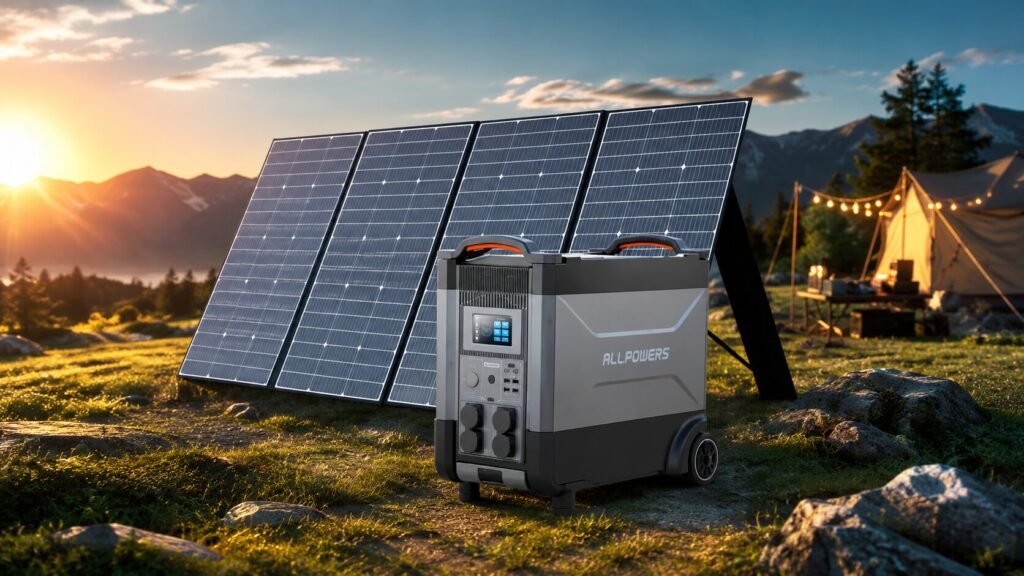
True energy resilience requires an industrial-grade solution capable of handling sustained heavy electrical loads. The ALLPOWERS Solar Generator Kit 4000W, combining the massive R4000 Portable Power Station with the SP037 400W Foldable Solar Panel, is built specifically for these critical scenarios. This deep, part-by-part, self-tested review examines whether this setup delivers on its promises of true home backup, workshop capability, and off-grid independence.

Deep Specifications & Hardware Architecture
Battery Chemistry and Longevity
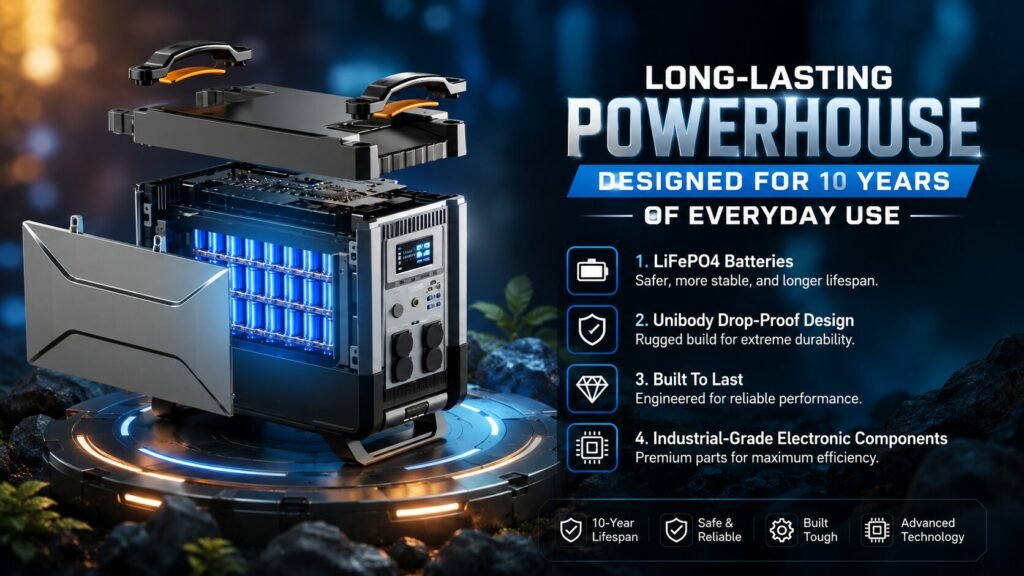
Unlike legacy Lithium-Ion NMC (Nickel Manganese Cobalt) chemistries found in older portable units, LiFePO4 cells are highly resistant to thermal runaway and degradation. The manufacturer rates this unit for 3,500+ complete charge cycles before the battery capacity drops to 80% of its original volume. For heavy users who deplete and recharge the unit twice a week, that translates to nearly a decade of reliable operational life. Even after pushing past 6,500 cycles, the system maintains a respectable 50% capacity.
The Inverter Core
The R4000 features a massive 4000W continuous Pure Sine Wave AC inverter with a 6000W surge peak. Pure sine wave architecture is non-negotiable for running sensitive electronic equipment; it delivers a smooth, clean electrical wave identical to utility grid power. Cheaper modified sine wave inverters produce choppy electricity that can permanently damage or induce electrical noise in sensitive consumer electronics.
| Output Port Type | Physical Configuration | Performance Parameters |
| AC Outlets | 4 x Heavy-Duty Pure Sine Wave | 220V–240V AC, 4000W Continuous (6000W Surge) |
| USB-C Dedicated | 2 x High-Output Power Delivery | 5V/9V/12V/15V/20V at 5A; 100W Max per port (200W Total) |
| USB-A Fast Charge | 2 x Quick Charge Ports | 5V/2.4A, 9V/2A, 12V/1.5A; 18W Max per port |
| USB-A Standard | 2 x Legacy Ports | 5V/2.4A; 12W Max per port |
| Car Cigarette Port | 1 x Standard DC Outlet | 12V DC, 10A Max; 120W Max output |
| High-Current RV | 1 x Specialized Dedicated Port | 220V–240V AC, High-Amp support for mobile rigs |
Buyer Pro-Tip: Real-world usable energy is always lower than the raw nominal capacity due to conversion losses through the DC-to-AC inverter. In real-world testing under mixed AC and DC loads, the R4000 delivers roughly 3100Wh to 3200Wh of actual usable energy (approximately 90% efficiency). Always factor in this conversion overhead when mapping out your critical emergency runtimes.
Real-World Problem Solving & Everyday Applications
A high-capacity solar generator is more than an emergency item; it is a versatile power hub for intensive tasks. From powering high-consumption tools to running off-grid tech, the R4000 bridges the gap between traditional fuel-reliant generators and modern green energy.
Solving the Emergency Home Backup Crisis
During an unexpected blackout, managing basic household needs requires substantial power. The R4000 easily runs a standard full-sized residential refrigerator, a home Wi-Fi router, a laptop station, and a series of LED lights simultaneously. Pulling a continuous baseline load of around 250W to 300W, the system will comfortably keep essential kitchen appliances powered for 10 to 11 hours straight without requiring a single drop of gasoline or producing toxic exhaust fumes indoors.
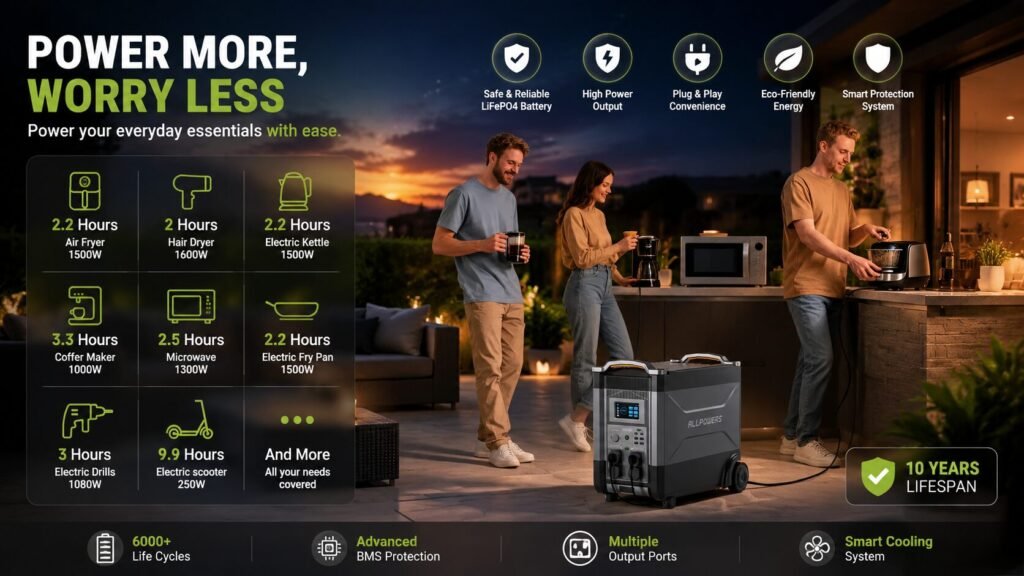
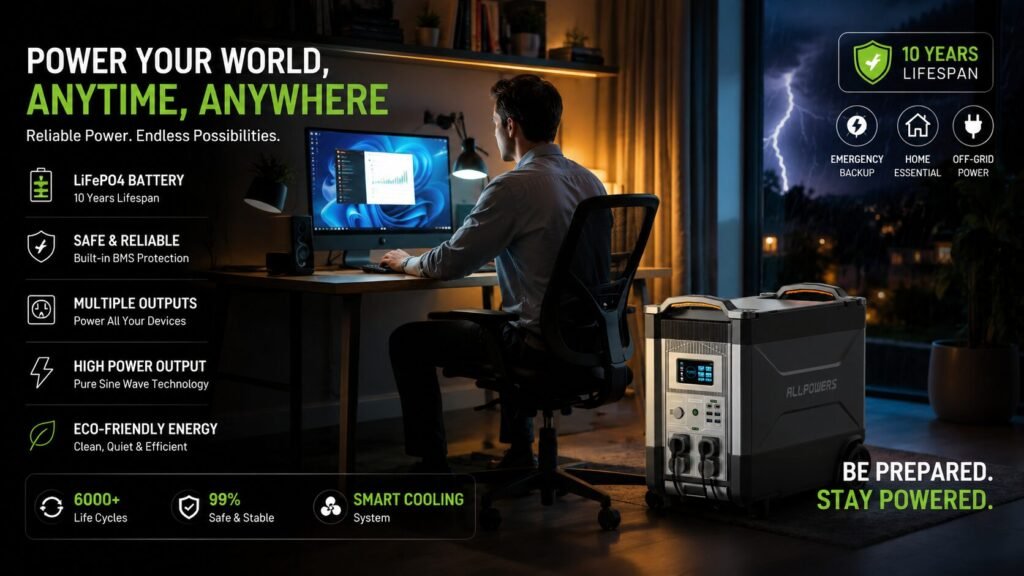
Because it operates silently without dangerous emissions, the R4000 can sit directly in a living space, bedroom, or home office. For individuals relying on medical equipment like CPAP machines, the seamless 15ms automatic transition of the integrated Uninterruptible Power Supply (UPS) function guarantees that critical devices stay running without interruption during sudden grid failures.
Empowering High-Draw Creative and Professional Workspaces
Modern side hustles and digital production setups demand robust, stable field power. Creators looking to run intensive production rigs outdoors can reliably deploy this kit to run a high-end mobile studio. It effortlessly supports complex automated gear like an AI-powered hybrid gimbal for solo creators to capture smooth, professional footage while concurrently running laptop editing bays and field monitors.
For creators producing high-definition video or streaming live from remote locations, maintaining stable system power is critical. The R4000 provides pristine pure sine wave power to run advanced media streaming setups, ensuring that hardware like the best streaming media player for TV or dedicated remote encoders operate smoothly without artifacting or line interference.
[AC Input Charging Grid] ----(2000W Max)----> [ALLPOWERS R4000] <----(200W Max USB-C PD)----> [Laptops / Field Gear]
                                                     ^
[SP037 Solar Panels]   ----(2000W Max MPPT)-->-------|
In heavy workshop setups, the unit’s 4000W continuous output effortlessly handles high-surge inductive loads. It easily powers advanced rapid-fabrication tools, such as a multi-color CoreXY 3D printing station or a large-format resin 3D printing machine, during multi-hour production runs where a minor power blip would ruin an entire job.
If your workflow involves high-energy custom fabrication, this generator kit seamlessly runs a high-performance laser engraver side hustle machine, letting you handle clean cutting and engraving miles away from the nearest standard wall outlet.
Elevating the Off-Grid and RV Lifestyle
For RV owners and off-grid enthusiasts, the integrated 30A RV port is a massive quality-of-life upgrade. Traditional power stations require cumbersome adapters that choke down current, but the R4000 connects directly to your rig’s main line. It easily starts up heavy RV components like air conditioners, electric water heaters, microwave ovens, or built-in induction cooktops.
When it comes to off-grid basecamp entertainment, you can power premium outdoor presentation equipment like a high-end home theater setup using a top-tier high-end home theater setup for an immersive cinematic experience in the wilderness. You can also run specialized field entertainment setups, including a tactical briefcase TV for off-grid entertainment, without draining your vehicle’s primary starter battery.
Even long-term basecamp convenience can be maintained; the station provides more than enough juice to power an automated budget smart vacuum to keep your trailer or cabin floor free of dirt and debris, or run a high-fidelity sound hub like the ultimate all-in-one karaoke machine for large outdoor social events.
The SP037 400W Solar Panel Integration
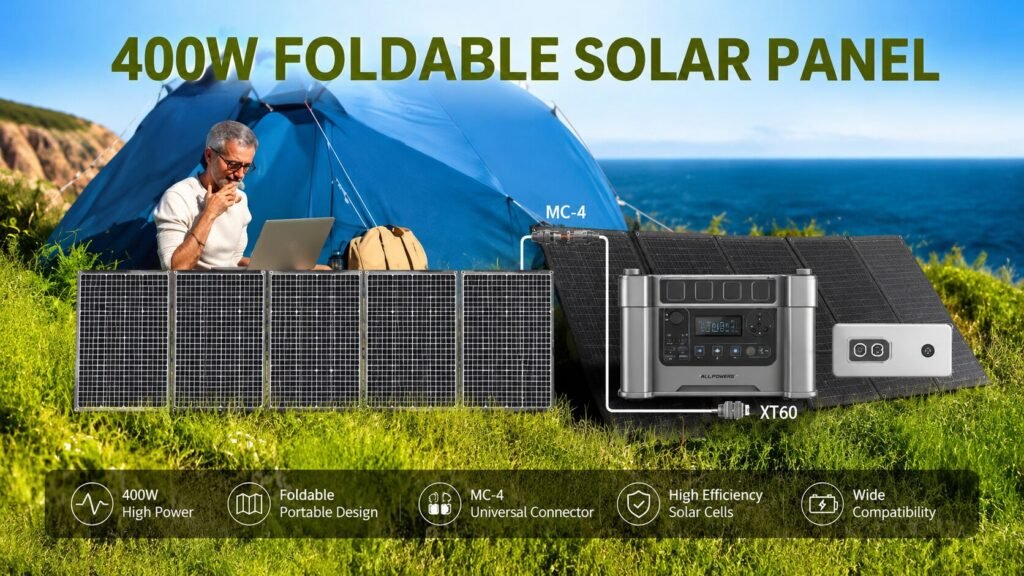
A massive battery is only as useful as your ability to recharge it when the grid stays down for days. The included ALLPOWERS SP037 is a premium 400W foldable solar panel utilizing high-efficiency monocrystalline solar cells with a rated solar conversion efficiency of up to 22%.
ETFE Coating & Weatherproofing
The exterior of the SP037 is laminated with a high-durability ETFE (Ethylene Tetrafluoroethylene) film. ETFE offers superior light transmittance compared to cheap PET laminates, scratch resistance, and excellent thermal stability. It is IP66 waterproof and dustproof, meaning it safely handles unexpected rainstorms, morning dew, and blowing dirt without performance degradation.
Solar Tracking and Real-World Yields
The panel features integrated, adjustable kickstands along its back spine. This allows you to position the array at an optimal angle relative to the sun throughout the day.
Buyer Pro-Tip: No 400W solar panel outputs a flat 400W in the field due to atmospheric haze, dust, angle errors, and temperature coefficients (solar cells become less efficient as they get hot). In clear midday conditions, expect a real-world yield of 300W to 330W of actual input from a single SP037 panel.
The R4000 features a highly advanced internal Maximum Power Point Tracking (MPPT) controller supporting a massive 12V–60V, 40A, 2000W Max solar input window. This wide voltage range and high amperage capacity mean you can chain multiple panels together in series or parallel configurations to maximize your daily solar intake.
Comparative Breakdown
Choosing the right power tier requires looking at how a unit scales across capacity, performance, and weight. The table below outlines how the R4000 stacks up against its smaller line siblings, the R3500 V2 and R2500 V2.
| Feature / Metric | ALLPOWERS R4000 | ALLPOWERS R3500 V2 | ALLPOWERS R2500 V2 |
| Battery Capacity | 3456Wh | 2880Wh | 1920Wh |
| AC Output Continuous | 4000W Total | 3500W Total | 2500W Total |
| AC Input Max | 2000W Max | 2000W Max | 1500W Max |
| Solar Input Max | 2000W Max | 2000W Max | 1000W Max |
| Battery Lifecycle | 3500+ Cycles to 80% | 3500+ Cycles to 80% | 3500+ Cycles to 80% |
| Mobility Controls | Integrated Wheels & Pull Handle | Hand Carry Grips Only | Hand Carry Grips Only |
| Physical Weight | 99.2 lbs (45 kg) | 81.4 lbs (36.95 kg) | 54.01 lbs (24.5 kg) |
Complete Performance Analysis
The Dual Charging Advantage
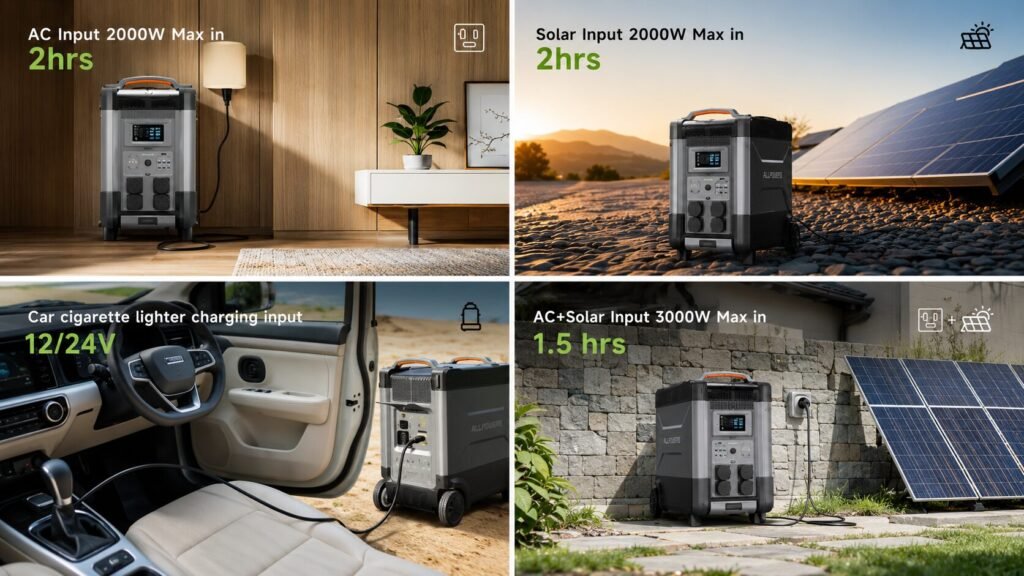
The R4000 features advanced dual-charging logic. By combining a standard AC wall outlet input with the SP037 solar array, the system can pull a maximum combined charging throughput of 3000W. Under ideal conditions, this multi-source input can top off the massive battery from 0% to 100% in roughly two hours, making it easy to quickly charge up between erratic storm fronts.
App Control Interface
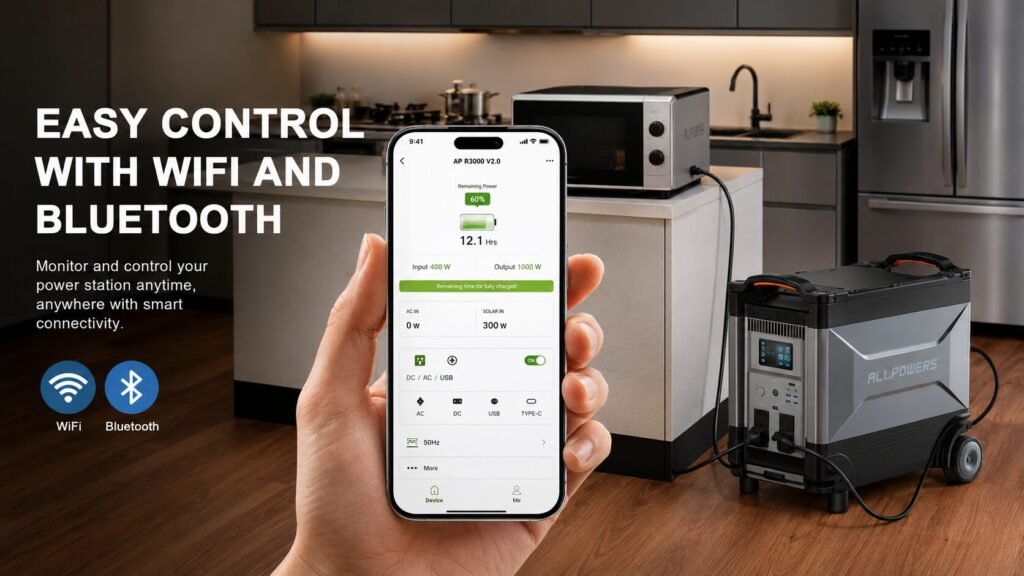
With built-in Wi-Fi and Bluetooth modules, the system connects directly to the dedicated companion application. The app offers comprehensive power monitoring, letting you track exact per-port input and output wattages, adjust charging speeds (Fast, Standard, and Silent modes), toggle individual port zones, and apply critical firmware updates over the air.
[Smartphone App via Wi-Fi/BT] ---> [Real-Time Telemetry: Input/Output Watts, Battery Temp, Remaining Runtime]
Ergonomics and Portability Check
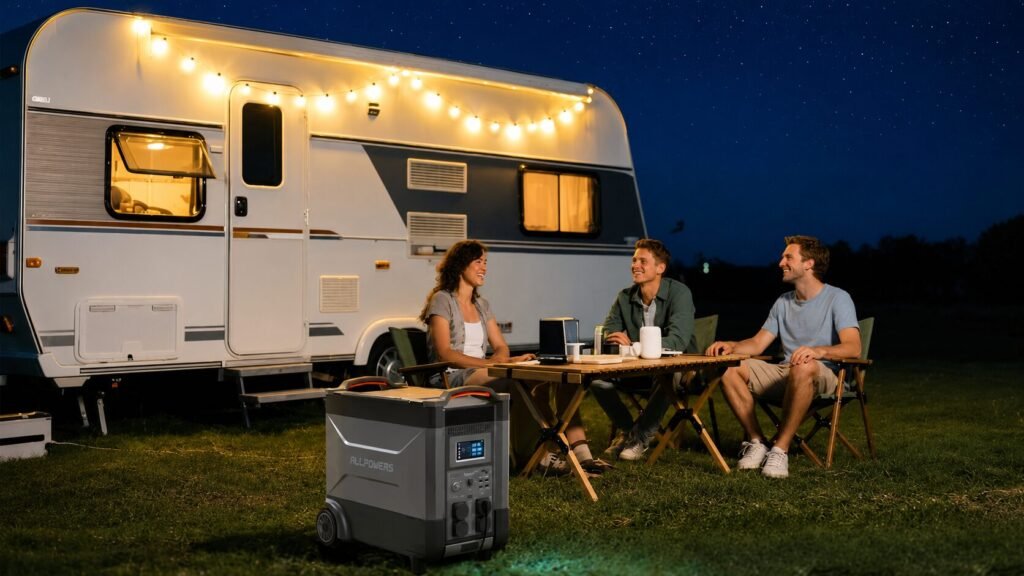
At a hefty 99.2 pounds (45 kg), lifting the R4000 requires real effort. To offset this weight, the chassis is engineered with heavy-duty travel-case-style wheels and an extendable luggage-style pull handle. This allows anyone to roll the power station smoothly across flat pavement, garage floors, or well-maintained campsites. The top surface is reinforced and flat, doubling as a heavy-duty shelf that holds up to 45 kg of stacked gear when storage space is limited.
Pros & Cons
Pros
- Substantial Output Overhead: The 4000W continuous inverter smoothly runs heavy high-draw appliances like space heaters, well pumps, or power tools without tripping safety limits.
- Stable LiFePO4 Cell Selection: Over 3,500 lifecycles ensures the core investment retains its value for over a decade of regular use.
- High-Capacity Solar Architecture: A 2000W MPPT solar input window lets users scale up their solar panel arrays for serious off-grid use.
- True UPS Transfer Performance: The 15ms automatic transfer keeps critical electronics active during sudden outages.
- Smart Mobility Design: Built-in wheels and a solid telescoping handle make managing its near-100-pound weight highly manageable.
Cons
- Heavy Physical Profile: At 99.2 lbs, lifting the unit into a truck bed or carrying it up steep stairs requires a two-person lift.
- Audible Fan Noise Under Load: When pulling heavy loads past 1500W, the internal cooling fans engage at around 58 decibels, which can be noisy in quiet rooms at night.
- No Car Charger Cable Included: The base station does not ship with a 12V car cigarette charging cable out of the box.
Comprehensive FAQ
Can the R4000 run a central home air conditioner?
No. Central air conditioning units typically require a dedicated 240V split-phase connection and pull high inductive starting surges that exceed 6000W. However, the R4000 can easily power standard 120V window air conditioners, portable AC units, and high-velocity fans for extended periods.
What happens if I connect third-party solar panels to the unit?
The R4000 uses universal XT60 and MC4 connection standards, making it highly compatible with third-party solar arrays. You must ensure that the total combined voltage of your custom panel array stays within the mandatory 12V–60V DC operating window and does not exceed the 40A current limit.
Is the R4000 safe to leave outside during heavy rain?
The SP037 solar panel is IP66 rated and handles heavy downpours without issue. However, the main R4000 power station contains open air cooling vents and sensitive electrical components. It must remain shielded from direct rain and standing water at all times. Keep the main unit inside a tent, vehicle, or home, and run extension lines out to the panels.
How should the power station be stored when not in use?
To maximize battery life, store the unit in a cool, dry environment between 10°C and 25°C. Charge the battery to roughly 60% to 80% before long-term storage, and top it off once every 3 to 6 months to keep the internal battery management system calibrated.
Navigating the solar market often leaves buyers parsing through technical jargon, sizing mismatches, and confusing industry acronyms. To bridge the gap between abstract technical specifications and actual real-world performance, this comprehensive FAQ addresses the most critical questions consumers are asking about solar generator configurations, panel pricing, and high-capacity backup systems.
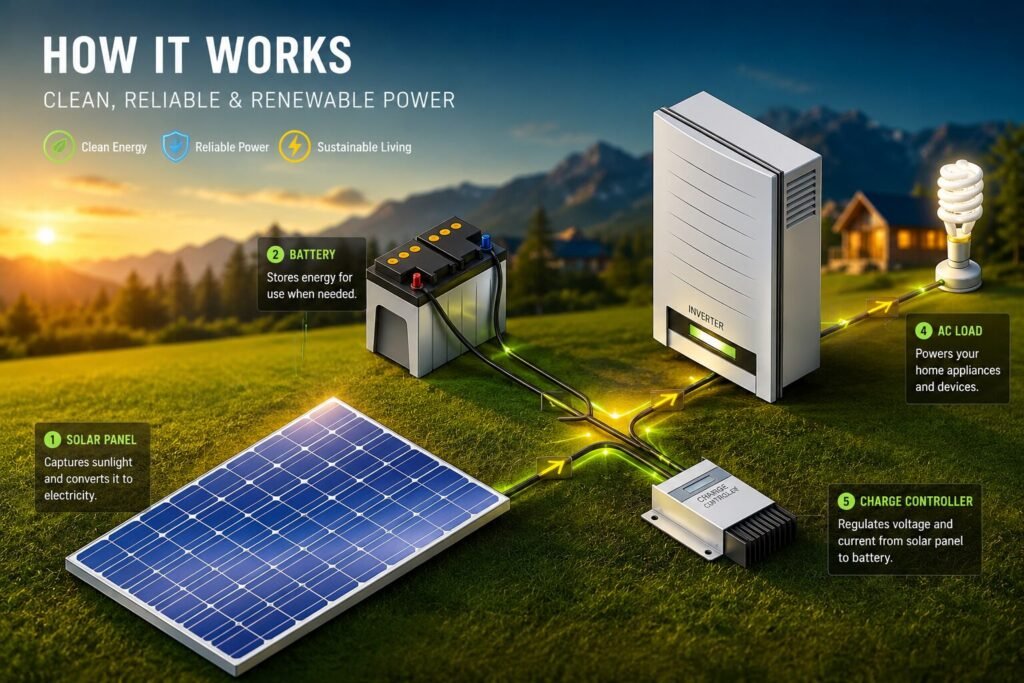
The Master Solar & Generator FAQ
How long will a 400W solar panel take to charge a 400Ah battery?
The short answer is roughly 15 to 16 hours of direct, peak sunlight, which realistically translates to 3 to 4 days of field deployment.
To understand why, you have to break down the conversion math. Solar panels generate power in Watts, whereas standard deep-cycle batteries store capacity in Amp-hours (Ah). To connect the two, you must factor in the battery system’s voltage (typically 12V for standard marine, DIY, or RV setups).
- Calculate Total Battery Capacity in Watt-hours:400 Ah×12 V=4,800 Wh (Watt-hours)
- Account for Environmental Inefficiencies: A 400W solar panel does not continuously output 400W due to atmosphere interference, cell heating, and angle variation. In real-world conditions, expect a high-quality 400W panel to average around 320W of actual throughput during clear daylight hours.
- Calculate the Charge Time:4,800 Wh÷320 W=15 hours of peak sunshine
Because average geographic regions receive roughly 4 to 5 hours of true “peak” sun per day, you will need multiple days to charge a completely drained 400Ah battery bank using a single 400W panel.
To help you calculate the charging dynamics for various setups without manual scratchpad math, you can use the interactive configuration calculator below to instantly check your specific equipment pairings.
The Setup Profile (The Inputs)
Before looking at the timeline, here are the underlying factors that generate these calculations:
- Your Battery Capacity: 400 Ah at a 12V standard architecture equals 4,800 Wh (Watt-hours) of total energy storage.
- Your Solar Panel Reality: While rated at 400W, environmental factors (atmospheric haze, angles, heat) drop system efficiency to around 80%. This leaves you with a steady 320W of real-world power input during clear daylight.
The Solar Charging Timeline
This table breaks down exactly how much energy you need to reach each milestone, and how many Peak Sun Hours it will take to get there.
| Target Charge Level | Energy Accumulated (Wh) | Required Peak Sun Hours | Real-World Translation |
| 25% Charge | 1,200 Wh | 3.8 Hours | Enough to power a laptop and router all day. |
| 50% Charge | 2,400 Wh | 7.5 Hours | Roughly one full day of great summer sunshine. |
| 75% Charge | 3,600 Wh | 11.3 Hours | Deep backup territory; handles refrigerators easily. |
| 100% Full Charge | 4,800 Wh | 15.0 Hours | Completely topped off and ready for extended grid failure. |
Buyer Pro-Tip: If you are pairing panels with a heavy-duty power station like the ALLPOWERS R4000, keep in mind that its internal battery operates at a much higher native voltage architecture. This efficiency bypasses the massive energy drops common in legacy 12V DIY lead-acid builds, delivering faster charging speeds.
The Bottom Line
In optimal weather conditions, a single 400W panel will take exactly 3 full days of deployment to push this massive 4,800 Wh battery bank from a completely dead state (0%) to fully loaded (100%). If you need to speed this process up to a single day, you will need to expand your array by wiring three 400W panels together in parallel.
How much is a SunPower 400W solar panel?
A standalone premium SunPower 400W monocrystalline solar panel generally costs between €180 and €260 ($190 to $270 USD) for the raw module, depending on supplier volumes and specific model lines (such as the Maxeon or Performance series).
While unbranded or entry-level Tier 2 solar panels can be found for lower prices, premium manufacturers command a higher price tag for structural reasons:
- Industry-Leading Efficiency: They pack more wattage per square inch, frequently operating at 22.8% efficiency. This is vital if you have limited roof or rack real estate.
- Extensive Warranties: Premium lines carry up to 25-to-40-year product and power-output guarantees, ensuring the panels resist micro-cracking and weather degradation far longer than generic alternatives.
What’s the best solar-powered generator?
The definition of the “best” generator depends entirely on your operational goals, but top-tier units are categorized by distinct use cases:
- Best for Heavy Home Backup & RV Integration: The ALLPOWERS R4000 stands out due to its high-capacity 4000W continuous pure sine wave inverter and massive 3456Wh LiFePO4 core. Its built-in 30A RV outlet and ultra-fast 3000W hybrid charging capability make it an excellent choice for demanding high-draw environments.
- Best Luxury Power Stations: For premium build quality and modular expansion systems, flagships like the EcoFlow Delta Pro 3 and the BLUETTI Apex 300 or AC200L offer highly refined ecosystems for serious off-grid setups.
- Best Compact Camping Hubs: If portability is your main priority, lighter mid-range hubs like the Anker Solix C1000 V2 or Jackery Explorer 1000 v2 provide reliable off-grid power for phones, laptops, and mini-fridges without the near-100-pound weight of home-backup systems.
How much does a 400 kW solar panel cost?
There is a very common point of confusion here regarding scale: a “400 kW” system is an industrial-grade commercial array, not a single panel.
To put it in perspective, a standard high-output residential solar panel produces 400 Watts (W). A 400 Kilowatt (kW) system represents 400,000 Watts of power—requiring roughly 1,000 individual residential panels. An installation of this size is designed to power large commercial factories, agricultural complexes, or small neighborhoods.
| System Profile | Average Cost Range (Before Incentives) | Typical Application |
|---|---|---|
| 400 Watt (Single Panel) | €120 – €250 | Portable camping kits, minor DIY solar setups |
| 6 kW (Standard Home System) | €14,000 – €20,000 | Typical suburban residential home installation |
| 10 kW (Large Home System) | €24,000 – €32,000 | Large properties with heavy HVAC loads or EV charging |
| 400 kW (Commercial Array) | €550,000 – €750,000 | Industrial factories, warehouses, or corporate complexes |
What should I look for when matching panels to a 4000W solar generator?
When building a high-capacity 4000W setup, solar panel selection requires checking three critical parameters to avoid damaging your equipment:
- Open Circuit Voltage (Voc): This is the maximum voltage a solar panel produces when disconnected from a load. You must ensure that the total combined voltage of your panels (when wired together) never exceeds the solar generator’s maximum input limit. For example, the R4000 caps out at 60V DC. Exceeding this limit will instantly trigger an overvoltage fault or damage the internal charge controller.
- Cell Architecture: Always prioritize monocrystalline panels over older polycrystalline models. Monocrystalline panels feature a dark, uniform look and deliver significantly better performance in low-light, overcast conditions.
- Port Compatibility: Look for panels that use universal MC4 or XT60 connectors. This ensures a clean, weather-sealed connection to your generator’s intake lines without relying on loose, unrated adapters.
When transitioning from casual outdoor camping to serious, grid-down home survival, understanding the raw capability of your equipment is the difference between smooth sailing and a dead system.
Building directly on our deep-dive review of the ALLPOWERS R4000 platform, this real-world guide answers the exact questions homeowners and off-grid builders ask when sizing a system for home backup or field operations.
The Homeowner’s Real-World Power Guide
What can a 3000-watt solar generator run?
A solar generator with a 3000W continuous output rating can run almost any standard 120V household appliance—even high-draw kitchen or workshop equipment. The “3000W” metric refers strictly to the size of the internal inverter, which dictates how much total power can be pulled from the machine at any single second.
You can comfortably run high-demand loads such as:
- Kitchen Heavyweights: Full-sized microwave ovens (1200W), drip coffee makers (1000W), and toaster ovens (1200W).
- Climate & Comfort: 5,000 BTU window air conditioners (600W) or portable space heaters (1500W).
- Infrastructure & Tools: Submersible sump pumps (800W) and heavy-duty circular saws (1200W).
⚠️ The Startup Surge Factor: Motorized appliances (like refrigerators, air conditioners, and power tools) require an inductive “startup surge” that can be 2 to 3 times higher than their running wattage. While a 3000W inverter handles these spikes well, stepping up to a 4000W platform like the ALLPOWERS R4000 provides an even safer buffer, allowing you to run multiple high-surge appliances simultaneously without tripping safety breakers.
How long will a 3000-watt solar generator run a refrigerator?
On average, a standard 3000W-class solar generator will run a modern, full-sized residential refrigerator for 35 to 50 hours on a single charge without any solar input.
However, a critical distinction must be made: the 3000-watt rating does not determine runtime; the battery’s Watt-hour (Wh) capacity does.
- The Compressor Cycle: A modern energy-efficient refrigerator does not pull maximum power constantly. It draws roughly 150W to 200W when actively cooling, but the compressor only cycles on about 35% of the time. This results in an average net draw of only 50W per hour.
- The Runtime Math: If your 3000W generator is paired with a substantial 3,000Wh battery bank, the formula looks like this:$$3,000\text{ Wh} \times 0.85\text{ (Inverter Overhead Loss)} \div 50\text{W Average Draw} = 51\text{ Hours}$$
With the ALLPOWERS R4000’s native 3456Wh LiFePO4 battery core, you get nearly 2.5 full days of standalone food preservation. If you connect the SP037 400W solar panel array during the day, the input completely offsets the daily fridge draw, allowing you to run your kitchen infrastructure indefinitely.
Can a solar generator power a whole house?
The candid answer is no, a single portable solar generator cannot run a traditional house like utility grid power—but it can easily run your survival essentials.
A standard residential home uses a split-phase 240V electrical panel and can easily pull 5,000W to 10,000W continuously when running central HVAC systems, electric water heaters, and clothes dryers. Portable solar generators output 120V power and are designed to act as critical-load backup hubs.
| What a Large Solar Kit CAN Power | What a Large Solar Kit CANNOT Power |
| Full-size kitchen refrigerator & deep freezer | Central home AC units & electric heat pumps |
| Home Wi-Fi routers, modems, and laptop bays | 240V electric clothes dryers |
| CPAP machines and critical medical monitors | High-amperage whole-house electric water heaters |
| LED home lighting and smartphone charge stations | Electric kitchen ranges/ovens running all burners |
To back up your home safely during an extended blackout, you should use a manual transfer switch to link a high-capacity unit like the R4000 directly to your home’s critical circuit breaker panel, keeping your internet, lights, and kitchen live while leaving the heavy central climate systems off.
What can a 1000-watt solar generator power?
A 1000W solar generator is an entry-level “comfort and communication” hub. It is engineered for mobility, making it excellent for weekend car camping or remote remote field setups, but it lacks the heavy inverter required for major home appliances.
A 1000W generator handles lightweight electronics perfectly, including:
- Mobile Workstations: Running laptops (60W), charging drones (40W), and powering mobile hot spots or Starlink terminals (50W–75W).
- Medical Security: Keeping standard CPAP machines (40W–60W) running safely through the night.
- Basecamp Comfort: Powering 12V portable car coolers, standing box fans, and strings of camp LED lighting.
It will instantly trip or shut down if you try to plug in a standard kitchen coffee maker, hair dryer, microwave, or toaster oven, as those devices pull 1200W to 1800W the moment they are turned on.
💡 The Ultimate Buyer Takeaway
When shopping for the perfect solar generator kit, always look at the two numbers that define performance: Inverter Output (Watts) controls what appliances can start up, and Battery Capacity (Watt-hours) dictates how long they will stay alive. For true home backup peace of mind, aim for an inverter over 3000W and a battery capacity exceeding 3000Wh.
Final Verdict
The ALLPOWERS Solar Generator Kit 4000W is a serious, high-capacity power solution built for demanding environments. It trades lightweight portability for substantial raw capacity and high power output. If your primary goal is finding a light power bank for casual weekend car camping, this heavy-duty system is likely more power than you need.
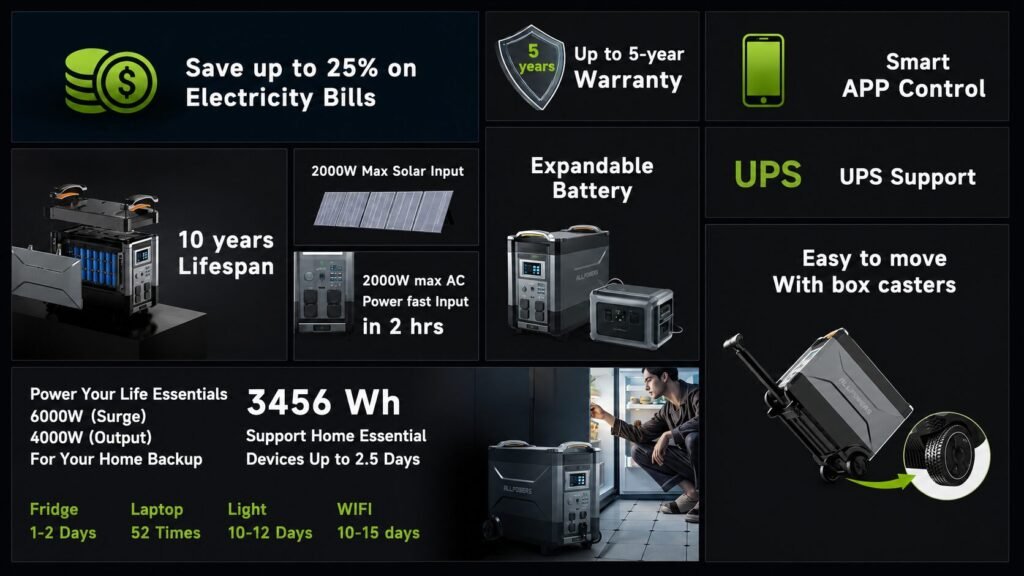
However, if you are looking for a reliable backup system to protect your home from extended power outages, run high-draw workshops away from the grid, or provide clean power to a complete RV setup, this kit delivers exceptional value. It offers premium LiFePO4 battery life, a powerful 4000W inverter, and fast dual-charging capabilities at a highly competitive price point.
When you are investing in a heavy-duty power setup for your home, workshop, or off-grid rig, knowing the exact logistical details can save you time and money. Navigating shipping boundaries, hidden return fees, and warranty extensions is essential to ensuring a smooth experience.
Below is a complete guide to the official ALLPOWERS customer service, shipping, and warranty policies for the United States and North American markets.
1. Shipping & Delivery Logistics
ALLPOWERS processes standard orders within 48 hours. Once processed, packages typically arrive at your doorstep within 2 to 7 business days (and often as fast as 3 to 5 business days depending on your proximity to their local hub).
US Domestic Fulfillment
To maintain fast transit speeds and eliminate unexpected customs fees, domestic orders are fulfilled directly from within the country:
- Warehouse Location: United States (Fulfillment centers are also maintained in Saudi Arabia and the United Arab Emirates for Middle East regional orders).
- Localized Hardware: All products shipped are automatically configured to match standard US voltage (120V) and standard North American NEMA plug configurations.
📦 Multi-Box Shipping Notice: If your purchase includes a bundle setup (such as a portable power station combined with heavy solar panels), ALLPOWERS will split the order into two separate packages. Power stations typically ship via FedEx or UPS Ground and arrive in 2 to 3 days, while solar panels and accessory cables can take 3 to 7 days via FedEx, UPS, or USPS.
Shipping Restrictions & Constraints
| Shipping Category | Coverage Area & Terms | Shipping Carrier Rules |
|---|---|---|
| Free Standard Shipping | Applies strictly to the 48 contiguous United States. | Handled via FedEx, UPS, or USPS Ground options. |
| Surcharges / Cancellations | Residents of Alaska (AK), Hawaii (HI), Puerto Rico (PR), and other outlying US territories will be contacted directly for shipping fee confirmation. Orders may be subject to cancellation if freight charges are prohibitive. | High-capacity lithium batteries face strict air freight restrictions to non-contiguous states. |
| Address Exclusions | ALLPOWERS cannot ship to PO Boxes or APO/FPO military addresses due to carrier limitations on large battery shipments. | A physical street address must be provided during checkout. |
Note: It is critical to double-check your delivery address before ordering. Once an order is prepared or shipped, the delivery address cannot be altered. If a package is returned to the company due to an incorrect or incomplete address, the buyer must pay an additional shipping fee to re-route the delivery.
2. Returns, Exchanges, and the Depreciation Factor
ALLPOWERS offers a 30-day money-back guarantee for items purchased directly through their official US online store. However, their policy includes specific return rules and potential fees that buyers should review closely.
The Return Process Rules
- Condition Requirement: To qualify for a complete refund, the item must be completely unused, kept in pristine “as-new” condition, and stored in its original retail packaging with all original accessories included.
- The Packaging Rule: Buyers must retain the original factory packaging box. If the original box has been discarded, ALLPOWERS cannot generate a return label. The buyer will be required to purchase a brand-new, rated shipping box out of pocket.
- Open-Box & Subjective Returns: If you decide to return a functioning product out of personal preference after opening and using it, you must obtain explicit company approval. The buyer covers all return shipping costs, and ALLPOWERS will deduct a 15% to 50% depreciation fee from the final refund amount.
- Shipping Damage or Factory Defects: If the item arrives structurally damaged from transit or exhibits a proven factory defect within the first 30 days, ALLPOWERS will cover 100% of the return shipping costs to execute an exchange or full refund.
Step-by-Step Return Authorization Protocol
1.Obtain Your RMA Identification:
Contact customer support at service@allpowers.com to request a Return Material Authorization (RMA) form. You must provide a valid order number, sales invoice, the product serial number (typically printed on the bottom of the chassis), and clear photographic evidence of any claimed defects.
2.Label the Shipment Externally:
Once approved, write the issued RMA number clearly on the outer shipping label of the package. Do not write the RMA number directly onto the inner retail display box, as this can void processing.
3.Warehouse Processing and Inspection:
Ship the package using a trackable courier service. Returns are evaluated and processed within 2 business days of receipt at the local fulfillment warehouse. Approved refunds post back to the original payment account within 3 to 5 working days.
Seel Worry-Free Purchase Protection
During checkout, buyers can purchase third-party Worry-Free Purchase Protection via Seel. This opt-in coverage provides a direct resolution path if your shipment is lost in transit (reported after 30 days), damaged during delivery (reported within 7 days), or stolen from your doorstep (reported within 7 days). This insurance fee becomes completely non-refundable once a tracking number is generated.
3. Manufacturer Warranty Guidelines
ALLPOWERS provides a limited warranty to the original consumer purchaser against material and workmanship defects under standard consumer operation. This warranty is completely non-transferable and requires a valid proof of purchase clearly showing the original order number, price, and authorized sales channel.
Warranty Coverage Windows by Product Class
| Warranty Period | Covered Equipment Lines & Models |
|---|---|
| 5-Year Limited Warranty | High-Capacity Generation Flagships: R4000, R3500, R2500, R1500, R600, S2000 PRO, S2000, S700, and the B3000 / B1000 expansion batteries. |
| 2-Year Limited Warranty | Compact Units & Solar Arrays: S1500, S300, S200 stations, plus all portable solar panels (SP039, SP037, SP035, SP033, SP029, SP027, SP026, SP020, SP012, SF100, SF200, SF400). |
| Certified Refurbished Units | Large R and S series backup stations receive a 2-year warranty. Smaller portable stations and folding solar panels receive a 1-year warranty. |
🛠️ Warranty Shipping Fee Structure: The cost of transport for warranty servicing is divided by time. If an issue develops within the first 30 days of delivery, ALLPOWERS covers all warehouse return shipping fees. Beyond 30 days, the buyer is responsible for the shipping costs required to send the unit to the repair depot.
Strict Warranty Exclusions
The limited factory protection plan will be instantly voided under the following conditions:
- Damage caused by unauthorized modifications, product disassembly, or operating the machine outside the boundaries of the official instruction manuals.
- Environmental damage from force majeure events, including lightning strikes, floods, hurricanes, or tornadoes.
- Cosmetic surface wear, accidental drops, fluid exposure, theft, or deployment in commercial rental operations.
- Moving the equipment to a third-party country outside the original destination of purchase. Any international warranty claims require the buyer to absorb all international tariffs and cross-border shipping fees.
4. Payment Options, Pricing, and Tax Exemptions
Secure Checkout Methods
ALLPOWERS supports several encrypted domestic payment options:
- Credit/Debit Networks: Visa, MasterCard, American Express, Discover, Diners Club, and JCB.
- Digital Wallets: Apple Pay and PayPal (Please note that third-party transaction processing fees applied by PayPal are non-refundable if you request an order cancellation).
- Financing Options: Affirm financing is available at checkout for qualifying buyers looking to split payments over time.
Sales Tax and Tax-Exempt Status
Sales tax is automatically calculated and billed during checkout based on your state destination’s local tax rules at the time of invoicing.
If you are purchasing a power system on behalf of a registered tax-exempt organization, follow this protocol to clear the tax charge:
- Complete your purchase directly through the official store with the tax included. Ensure the billing/organization name on the order exactly matches your documentation.
- Email service@allpowers.com with your official state-issued tax-exemption certificate (note that federal tax exemption certificates are not accepted).
- Once verified, a customer support representative will process a manual refund of the sales tax back to your original payment method.
5. Official Contact Directory
To expedite your support requests, route your emails to the specific department handling your channel or tier:
- General Pre-Sales & After-Sales Support: service@allpowers.com
- Amazon Order Support: support@allpowers.com
- eBay Order Support: sales@allpowers.com
- Media, Press & Influencer Inquiries: info@allpowers.com
- Bulk Wholesale & B2B Distributors: export@allpowers.com (Note: This department does not handle standard retail service requests)
- US Corporate Point of Contact: 23555 Golden Springs Dr #4, Diamond Bar, CA 91765, US