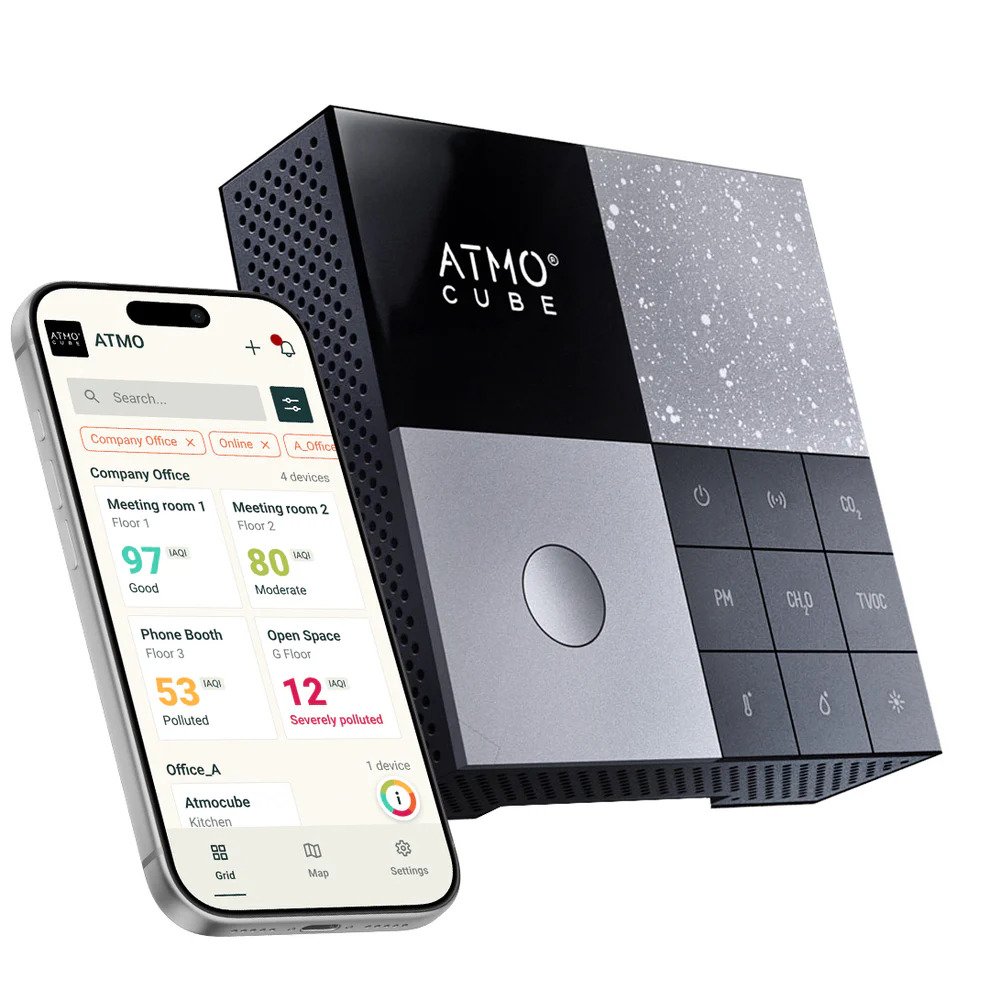
Looking for a reliable indoor air quality monitor? This Atmocube review covers real-time tracking, 11 environmental sensors, smart integrations, and whether it’s worth the $399 price.
The Indoor Trap: Life Behind Four Walls
Let’s talk about something most of us ignore: the air we’re breathing right now.
Statistically, we spend about 90% of our lives indoors. Whether you’re grinding away in a home office, sleeping, or watching Netflix, you’re likely inside a sealed environment. And while we’ve been trained to worry about smog in the city or exhaust from cars, the reality is that the air inside your home or office can be two to five times more polluted than the air outside.
I’ve spent years looking at smart home gear, and air quality monitors are often the “forgotten” category. We buy smart thermostats for comfort and smart cameras for security, but we breathe about 3,000 gallons of air every single day without knowing what’s in it.
That’s where the Atmocube — Smart Indoor Air Quality Monitor for Healthy Living comes in. This isn’t just another $50 plastic gadget that gives you a vague “green or red” light. It’s a professional-grade environmental intelligence system. After digging into the specs and the real-world utility of this device, I wanted to put together a comprehensive look at what sets it apart in an increasingly crowded market.
Why Indoor Air Quality (IAQ) Actually Matters
Before we dive into the Atmocube price and features, we need to understand the “why.” Indoor Air Quality (IAQ) isn’t just a buzzword for wellness influencers; it’s a critical factor in how your brain and body function.
When we talk about poor air quality, we’re usually dealing with three main culprits:
- Carbon Dioxide (CO2): Ever feel that 3:00 PM “brain fog”? In a closed room with a few people, CO2 levels can skyrocket. High CO2 doesn’t just make you sleepy; it actively impairs your decision-making and cognitive function.
- Particulate Matter (PM): These are tiny particles—dust, pollen, smoke—that are small enough to enter your lungs and even your bloodstream.
- Volatile Organic Compounds (VOCs): These are gases emitted by everything from your new IKEA desk to the “lemon fresh” cleaner you used this morning.
If you’re a remote worker, a parent, or an office manager, ignoring these factors is essentially a productivity and health tax. The Atmocube smart indoor air quality monitor is designed to make these invisible threats visible.
What is Atmocube?
The Atmocube is positioned as an advanced, all-in-one monitor for real-time environmental intelligence. While some brands focus solely on the “consumer” look, Atmocube balances a sleek aesthetic with enterprise-grade internals.
It is designed for:
- High-Performance Home Offices: Where focus and CO2 levels are linked.
- Families: Especially those with children or members with asthma/allergies.
- Modern Workspaces: Helping office managers maintain compliance and employee wellness.
- Smart Home Enthusiasts: People who want to trigger their HVAC or air purifiers based on precise data.
At a sale price of $399 (regularly $459), it’s clearly an investment. But as the saying goes, “If you can’t measure it, you can’t manage it.”
Watch the video below to see:

Design and Build Quality: Professional Minimalism
When you first see the Atmocube, it’s clear it wasn’t designed to be hidden behind a plant. It has a modern, minimalist square design that feels solid and premium.
Placement Flexibility
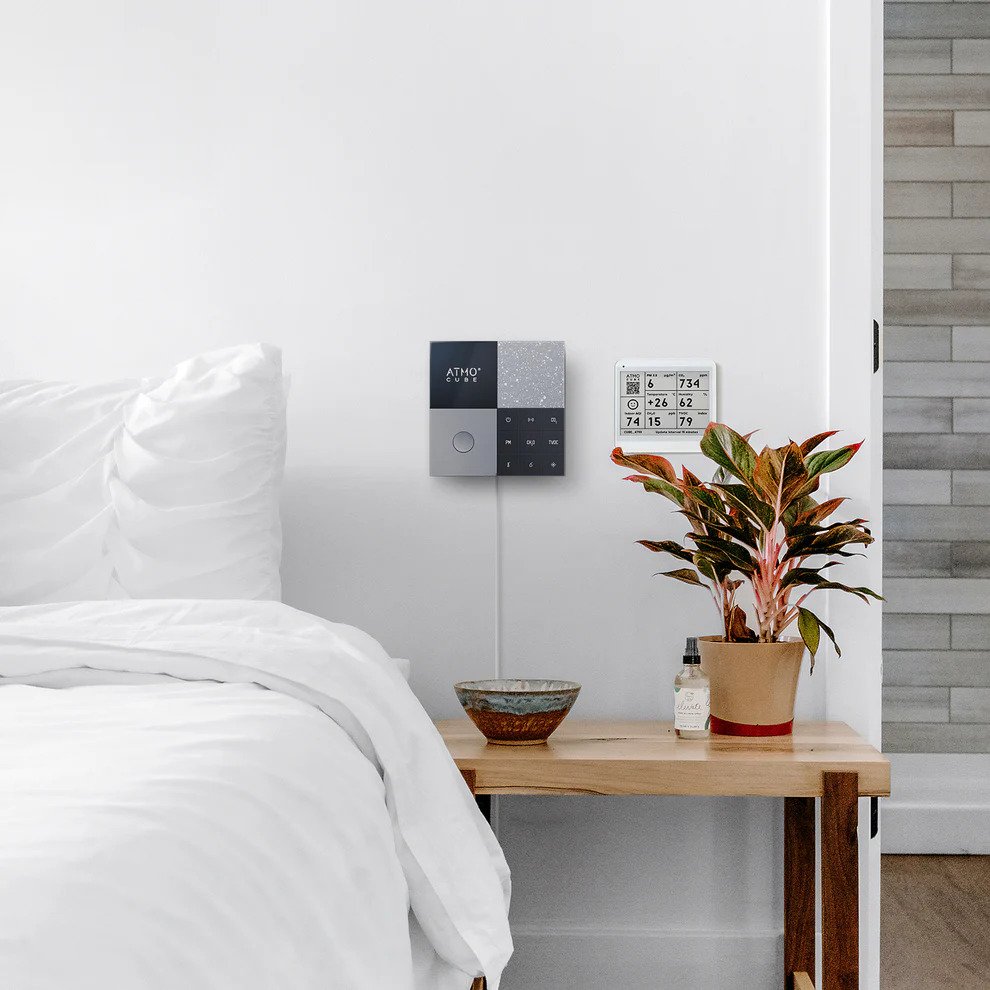
One of the standout design features is its versatility. You can place it on a desk or mount it to a wall. For office settings, the wall-mount option is a game-changer because it keeps the sensors at breathing height—where the data actually matters.
The Feedback Loop
The device features a clear LED indicator that changes color based on overall air quality. It’s a simple, non-intrusive way to know if you need to crack a window without having to pull out your phone. There is also an optional version with a built-in display if you prefer seeing the raw numbers at a glance.
The 11-Sensor Breakdown: What Are You Actually Measuring?
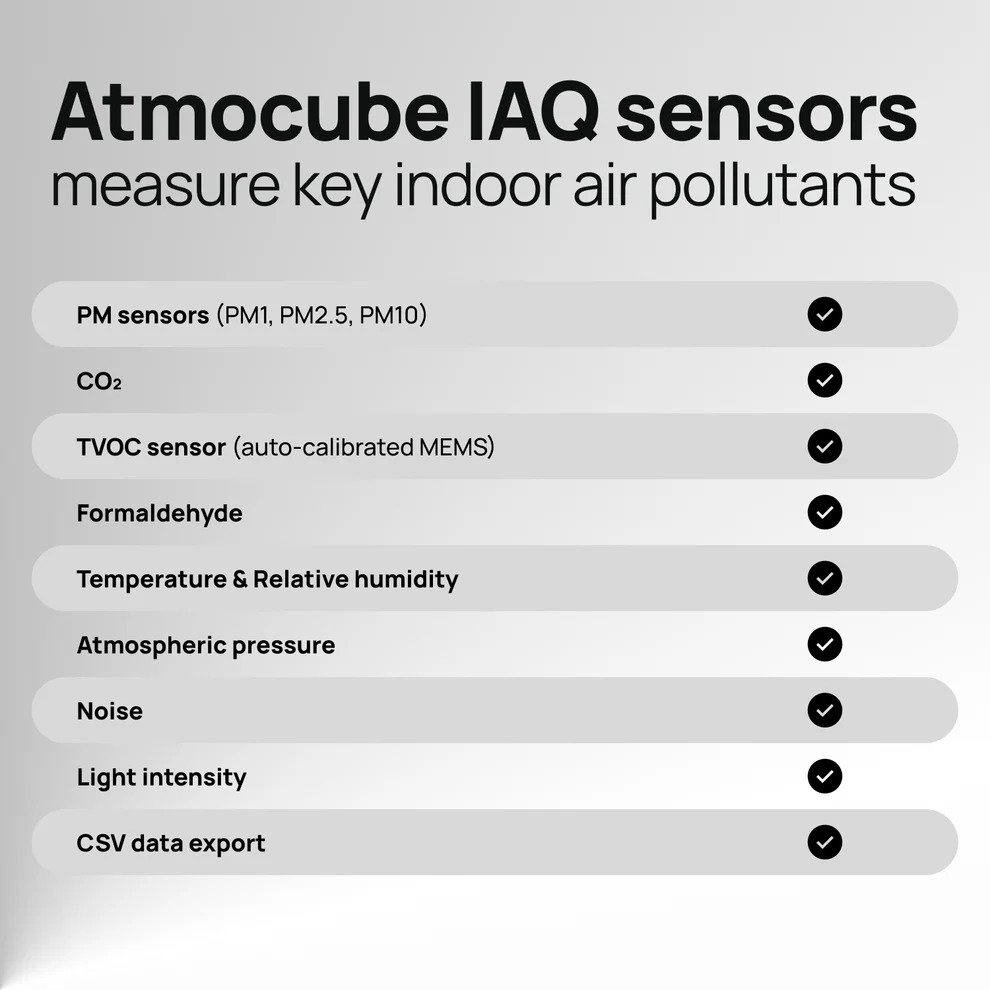
This is where the Atmocube review gets technical, because the sensor array is what justifies the price. Most budget monitors give you 3 or 4 data points. The Atmocube gives you eleven.
1. Particulate Matter (PM1, PM2.5, PM10)
Atmocube doesn’t just lump “dust” into one category. It tracks three sizes of particles. PM2.5 is the standard for smoke and fine dust, but PM1 is even more dangerous as it can penetrate deep into the cardiovascular system.
2. Carbon Dioxide (CO2)
High CO2 is the primary cause of “stale air” feelings. If you’re in a meeting room or a bedroom with the door closed, you’ll see this spike. Monitoring this helps you understand when your ventilation is failing.
3. TVOCs (Total Volatile Organic Compounds)
These are chemicals from paints, carpets, and cleaning supplies. If you’ve ever had a headache after unboxing new furniture, you’ve experienced VOCs.
4. Formaldehyde (CH2O)
This is a major inclusion. Formaldehyde is a common carcinogen found in many building materials and pressed-wood furniture. Most consumer-grade monitors skip this because the sensor is expensive and hard to calibrate. Having it here is a huge win for home wellness.
5. Microclimate (Temp, Humidity, Pressure)
The basics, but essential. Proper humidity prevents mold growth and keeps your skin and sinuses from drying out.
6. Environmental Context (Light & Noise)
Why track light and noise in an air monitor? Because “healthy living” is holistic. High noise levels increase stress, and poor lighting affects your circadian rhythm. Atmocube treats your room as a complete ecosystem, not just a box of air.
Smart Connectivity: Built for the Modern World
The Atmocube is perhaps the most well-connected air quality monitor system I’ve seen. It doesn’t lock you into a single ecosystem.
- Wi-Fi & Bluetooth: Standard for home use.
- Ethernet & PoE (Power over Ethernet): This is massive for offices and smart buildings. PoE allows you to power the device and transmit data over a single cable, eliminating the need for power outlets near every monitor.
- Enterprise Protocols: With support for MQTT, Modbus RTU, and Modbus TCP, the Atmocube can talk to industrial building management systems.
- REST API: If you’re a coder or a smart home “prosumer,” the API allows you to pull your air quality data into custom dashboards or use it to trigger complex home automation.
The Mobile App and Cloud Dashboard Experience
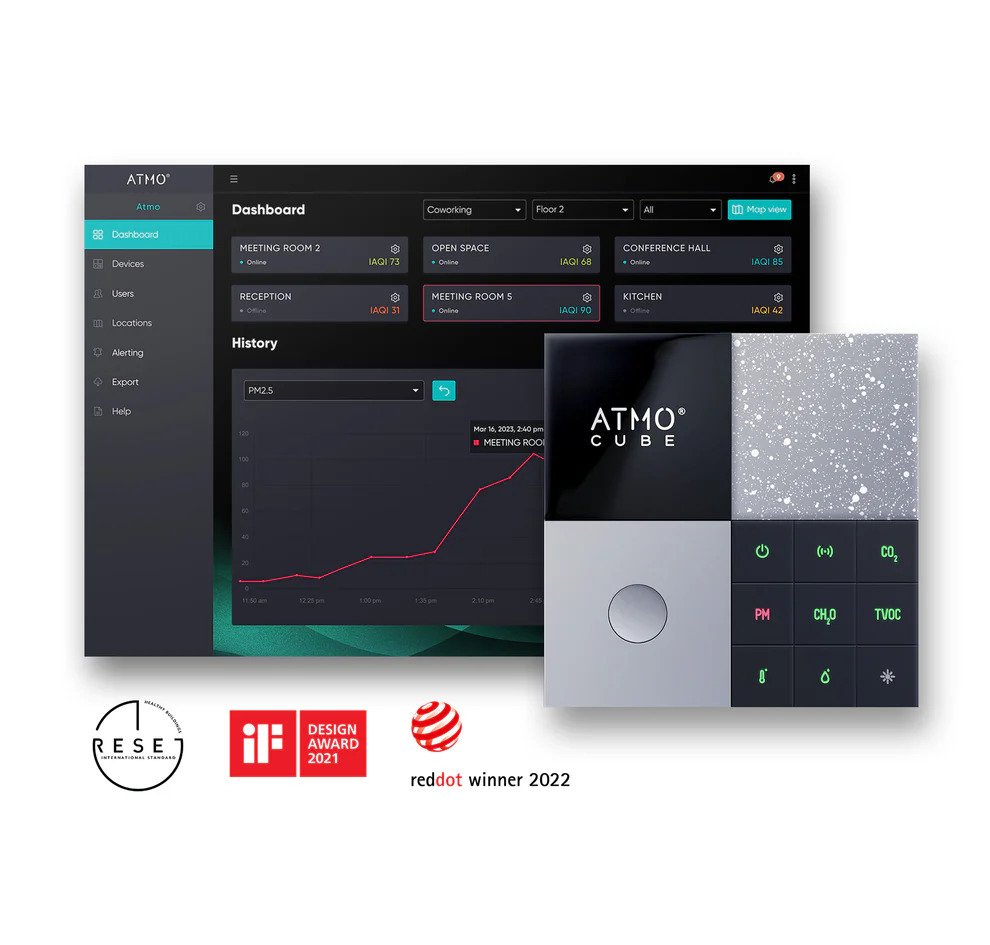
A sensor is only as good as the data it presents. The Atmocube app is clean and intuitive, but the Cloud Dashboard is where the real power lies.
1-Minute Data Intervals
Most battery-powered monitors update every 10 to 15 minutes to save power. Because the Atmocube is always powered (via USB-C or PoE), it tracks data at 1-minute intervals.
This high-frequency data is crucial for “diagnosing” your home. If you see a spike in PM2.5 at exactly 7:00 PM every night, you might realize it’s because that’s when you start cooking. Without 1-minute data, those spikes often get smoothed out and lost.
Real-World Use Cases: Home vs. Office
The Home Office Use Case
If you’re looking for the best indoor air quality monitor for home offices, the Atmocube is a productivity tool. I’ve noticed that when CO2 hits 1,200 ppm, my concentration tanks. With the Atmocube, I can set an alert to remind me to open the window before I lose my focus.
The Corporate/Commercial Use Case
For office managers, the Atmocube provides a “Health and Safety” audit trail. You can prove to employees that the HVAC system is working and that the air is safe. The historical trends help identify “dead zones” in the office where air is stagnating, allowing for better desk placement and ventilation upgrades.
Global Relevance: Why it Matters in the USA and India
Air quality is a global issue, but the problems vary by region.
- In the USA: Our homes are often “too tight.” We have great insulation, which saves energy but traps indoor chemicals and CO2. The Atmocube review USA market often focuses on VOCs and radon/chemical exposure.
- In India: The focus is often on outdoor pollution leaking in. When searching for an indoor air quality monitor India or the best air quality monitor India, the priority is often PM2.5 and PM10 due to high smog levels. The Atmocube’s high-precision laser sensors are ideal for these high-pollution environments, helping users know exactly when to turn their air purifiers to “Max.”
The Showdown: Atmocube vs. The Heavy Hitters
Let’s be real: the air quality market is getting crowded. While you can find a generic monitor for the price of a couple of pizzas, they usually don’t tell the whole story. If you’re dropping $399, you want to know how it stacks up against the “celebrities” of the sensor world.
Here is the 2026 breakdown of the best indoor air quality monitors on the market:
| Product | Best For… | The Vibe | Price (Est.) |
| Atmocube | The Pro Choice | 11 sensors (including Formaldehyde & Noise). Total home/office intelligence. | $399 |
| Airthings View Plus | Radon Hunters | The gold standard for Radon tracking + essential PM2.5 and $CO_2$. | $299 |
| Awair Element | Smart Home Fans | Gorgeous design with a clean app. Tracks the “Big 5” pollutants. | $199 |
| AirGradient One | The DIY Techie | Open-source transparency. Best for people who want to own their data. | $195 |
| Qingping Lite | The Budget Pick | Compact, cute, and handles the basics ($CO_2$, PM2.5) without the fluff. | $100 |
| Temtop Handheld | On-the-Go | Not a permanent fixture—great for checking different rooms or travel. | $90 |
The Verdict: Why These Aren’t All Created Equal
Look, the air quality market is officially crowded. You can find a $50 “bargain” monitor on Amazon that looks cool, but here’s the tea: you usually get what you pay for. If you’re serious about your health, you need to look under the hood.
Stop the Guesswork (NDIR vs. eCO2)
If you’re eye-balling those budget monitors like Govee or other entry-level brands, be careful. Most cheap units use “equivalent” $CO_2$ (eCO2) sensors. That’s just a fancy, marketing-speak way of saying the device is guessing your $CO_2$ levels based on other gases in the air.
The Atmocube is different. It uses a true NDIR (Non-Dispersive Infrared) sensor. That means it’s actually “seeing” the carbon dioxide molecules, giving you the real deal—not just a guestimate. If you’re a remote worker trying to avoid that 3:00 PM brain fog, accuracy isn’t optional; it’s a requirement.
Radon King vs. Environmental CEO
It really comes down to what you’re trying to protect. If you live in an area where radioactive soil gas is a major threat, the Airthings View Plus is the undisputed champ for Radon. But here’s where the Atmocube pulls ahead: it offers “lifestyle” data that the others ignore. The Atmocube tracks noise and light pollution, plus Formaldehyde ($CH_2O$)—a nasty carcinogen found in everything from new furniture to flooring that most consumer monitors skip entirely.
The Bottom Line
If you’re building a “WELL-certified” home office or you’re a parent who wants the absolute best for your kids’ lungs, the extra investment in a pro-grade tool like the Atmocube or the Airthings View Plus is a total no-brainer. Don’t settle for a gadget when you can have an environmental intelligence system.
Atmocube Price & Value Analysis: Is it Worth $399?
Let’s be honest: $399 is a significant investment for an air quality monitor for home use.
However, you have to look at what you’re getting. To get a separate, calibrated sensor for Formaldehyde, PM1, and CO2, you would easily spend over $600. The Atmocube consolidates 11 sensors into one beautiful, connected device.
If you are a casual user who just wants to know if it’s “stuffy,” this might be overkill. But if you are managing a health condition, building a “well-certified” office, or living in a high-pollution area, the Atmocube price is justified by the precision and the “professional” nature of the hardware.
Pros and Cons
Pros:
- Unmatched Sensor Depth: 11 parameters including Formaldehyde.
- High Precision: 1-minute data intervals for real-time troubleshooting.
- Build Quality: Professional-grade, not a “toy” feel.
- Connectivity: Ethernet, PoE, and MQTT for the ultimate smart home/office setup.
- Dashboard: Excellent historical data visualization.
Cons:
- Price: At $399, it’s a premium purchase.
- Power: No battery backup; it must stay plugged in (though this allows for the high-frequency sampling).
- Size: Slightly larger than some ultra-portable options, but still very manageable.
FAQ: Everything You Need to Know
What is Atmocube even used for?
Atmocube is a beast when it comes to keeping your space safe. It monitors 11 different environmental factors in real-time, helping you sniff out pollutants and microclimate issues in your home or office before they become a problem. No cap, it’s like having a high-tech bodyguard for your lungs.
Is Atmocube actually worth the hype?
If you’re tired of “basic” sensors and want data that’s actually accurate, then 100% yes. It’s one of the few monitors on the market that includes dedicated Formaldehyde and Noise/Light sensors. It’s a certified W for anyone who values precise, high-level air quality tracking.
Is it a major vibe for your home?
Absolutely. It’s a game-changer for modern smart homes. If you want to automate your environment—like having your air purifier kick in the second the air quality dips—this is the gear you need to make it happen seamlessly.
Will it level up your office setup?
It’s arguably the best in its class for the workplace. Thanks to PoE support (Power over Ethernet) and a multi-device cloud dashboard, it has that “main character energy” for office managers who need to monitor an entire building from one screen.
Does it track CO2 and PM2.5 with high precision?
Yes, and it doesn’t play around. It uses high-precision sensors for both CO2 and PM2.5, giving you way more reliable data than those budget alternatives. You’re getting the real tea on what’s actually in your air.
Can you link it to your Smart Home?
For the tech-savvy crowd, this is a massive win. You can integrate it via REST API and MQTT, meaning it plays nice with Home Assistant, professional HVAC controllers, and more. It’s built to fit right into your ecosystem.
Is it a certified W for India?
Big yes. Since it tracks various particulate sizes (PM1, 2.5, and 10), it’s incredibly effective in areas dealing with high ambient pollution. It’s tough enough to handle the environment and keep your indoor air quality on point.
Where can you cop an Atmocube online?
Ready to upgrade? You can snag one directly from the official Atmocube store or through authorized tech and wellness retailers. Grab yours and start breathing better today.
The Deep Dive: Your Air Quality Burning Questions
I get it—buying a $400 monitor is a big step. Here are the answers to the questions that usually pop up when people are diving down the air quality rabbit hole:
Do Indoor Air Quality Monitors Actually Work?
Short answer: Yes, but it’s a total “you get what you pay for” situation. Those cheap $30 sensors you find on discount sites often “estimate” things like CO2 based on VOC levels, which is basically just an educated guess—no cap.
Heavy hitters like the Atmocube or Airthings use actual NDIR sensors and laser scattering to give you lab-grade accuracy. They don’t just “work”—they have massive aura because they give you the hard data you need to justify upgrading your HVAC or finally buying that high-end air purifier. If you want the real tea on what you’re breathing, you’ve got to go with the pro-grade gear.
Which Indoor Air Quality Monitor Is Actually the Best?
There’s no “one size fits all” answer here—it depends on your mission. If you’re losing sleep over lung health and radon, the Airthings View Plus is your MVP. If you want the full “CEO of my home” experience (tracking everything from furniture chemicals to noise levels), the Atmocube is the undisputed winner. And if you’re just looking for a budget-friendly “vibes check” on the basics, the Qingping Lite is a solid, reliable bet.
Is There a Specific Device to Test Air Quality in a Home?
Absolutely. While you could hire a professional for a pricey one-time test, a smart monitor is actually a better investment. Why? Because your air quality changes by the hour. The air in your house when you’re searing a steak at 7:00 PM is completely different from when you’re sleeping at 3:00 AM. Devices like the ones we’re talking about today give you a 24/7 “live feed” of your home’s health so you can spot patterns, not just a single snapshot.
What State is the Easiest to Breathe In?
If you’re looking to move for the “cleanest” air in the USA, states like Hawaii, Alaska, and Vermont consistently crush the charts for low outdoor pollution. But here is the kicker: even if you’re living in a cabin in the middle of a Vermont forest, your indoor air can still be trash. If your home is sealed too tight and full of VOCs from paint or cleaning supplies, you could still be breathing “stale” air. Clean air starts inside your four walls!
Final Verdict: The Professional’s Choice for IAQ
The Atmocube — Smart Indoor Air Quality Monitor for Healthy Living isn’t trying to be the cheapest monitor on the market. It’s trying to be the most comprehensive.
After looking at the sensor array, the 1-minute data intervals, and the incredible connectivity options (PoE is a massive “win” in my book), it’s clear that this is a top-tier choice for anyone serious about their environment. Whether you’re a developer wanting to geek out on air data or a business owner wanting to protect your staff, Atmocube delivers.
If you’re tired of “guessing” why you’re tired, or you’re worried about the hidden chemicals in your new home, the Atmocube provides the clarity you need.
Still Searching? Here’s What Other IAQ Geeks Are Looking For
If the Atmocube isn’t quite the right fit, or if you have a very specific concern, you aren’t alone. Here’s what the community is currently buzzing about:
The “Mold” Question: Can a Monitor Actually Sniff Out Spores?
If you’re hunting for an indoor air quality monitor for mold, here’s the reality check: most devices don’t literally “smell” mold spores floating around. Instead, they act like a high-tech early warning system. By tracking humidity levels and VOC spikes (the two biggest red flags for fungal growth), a monitor like the Atmocube tells you when your room is turning into a petri dish. If your humidity is constantly over 60%, you aren’t just breathing air—you’re basically inviting mold to move in rent-free.
Reddit Favorites: What the r/AirQuality Community is Hyping
If you spend any time on Reddit (r/AirQuality or r/SmartHome), you know that community does not play around with data accuracy. The current Reddit darling is the AirGradient One, mostly because it’s open-source and totally transparent. Redditors love being able to see exactly how their data is handled without a “black box” corporate algorithm. While the Atmocube is the sleek, professional choice, the AirGradient is the go-to for the DIY crowd who wants to geek out on the raw code.
For the Bird Owners: Why Your Feathered Friends Need a Sensor
Searching for an indoor air quality monitor for birds? You’re a top-tier pet parent. Birds have incredibly sensitive respiratory systems—honestly, they’re the “canary in the coal mine” for a reason. Things that humans barely notice, like a burnt Teflon pan or a strong scented candle, can be a total emergency for them. You need a monitor with zero lag on PM2.5 and VOC tracking to make sure your home stays a safe flight zone for your feathered besties.
Professional vs. DIY: Should You Buy Local or Go Pro?
You can definitely find an indoor air quality monitor near me at big-box spots like Home Depot or Lowe’s, but those are usually basic consumer gadgets. They’re fine for a “vibes check,” but for a true professional air quality monitor experience that integrates with your whole-house HVAC or office dashboard, you have to go enterprise-grade. Moving up to something like the Atmocube is the difference between a toy thermometer and a full-blown weather station for your lungs.
The Final Word: Building Your Total Air Wellness Ecosystem
Ultimately, bringing an Atmocube into your space is about closing the loop on your environmental intelligence. It’s the “brain” that tells you exactly when and why your air quality is dipping, but remember that monitoring is only the first step—you still need the muscle to fix it. If your Atmocube data reveals a persistent battle with dust or seasonal pollen, pairing it with a heavy hitter like the Levoit Core 300-P Air Purifier is the most effective way to actually scrub those particles from your life.
Think of the Atmocube as your home’s stationary “mission control,” but don’t let your awareness stop at the front door. For those who want that same granular peace of mind while commuting, traveling, or working from a local cafe, the Atmotube PRO 2 is the perfect portable sibling to fill that gap. By combining professional-grade monitoring with targeted purification, you’re moving past the guesswork and finally taking full control of the air you breathe every single day.
Ready to take control of your indoor environment?
The air you breathe is the foundation of your health. Don’t leave it to chance.
The Real Talk on Data (Reliability)
First things first: the Atmotube is a cool piece of tech, but it’s not a medical device.
- Snapshot, Not a Lab: The data you see is “raw.” It hasn’t been vetted by government agencies. Think of it as a helpful “snapshot” of a moment in time, not a scientific verdict.
- Personal Use Only: Use the stats for your own info and enjoyment. If you’re making big health moves, talk to your doctor, don’t just rely on the app.
- No Warranties: The company is pretty clear—they don’t offer a “it will work perfectly forever” guarantee. If it breaks because of wear and tear, moisture, or an accidental drop, that’s on you.
Canceling Your Order
Changed your mind? You’ve got to be fast.
- The 24-Hour Window: Most orders start processing within 24 hours. Once the warehouse gets moving, you usually can’t stop it.
- The “Oops” Fee: If you cancel before it ships, expect a 5-10% cancellation fee (this covers their merchant processing costs).
- Refusing Delivery: If the package shows up and you just say “no thanks” without opening it, you’ll still be hit with restocking and shipping fees.
Shipping & Customs
Atmotube ships to the US, UK, EU, Canada, and a handful of other spots (like Japan, NZ, and Australia).
- The Wait Time: In the US, it’s usually 3-5 business days via USPS, but can take up to 12 if things are backed up. International? Give it at least 20 working days before you start panicking.
- Customs & Taxes: If you’re outside the US/UK/EU, you might get hit with import taxes or customs fees. Atmotube doesn’t pay these for you, and they can’t tell you how much they’ll be. Heads up: If you refuse to pay customs, they’ll deduct the shipping costs from your refund.
- Lost Packages: If the tracking says “Delivered” but it’s not there, you have to talk to the post office or the police. Atmotube won’t reship or refund orders marked as delivered.
Returns: The “No-Go” Zone
This is the big one: All sales are final.
- Defective Items Only: You can’t return it just because you don’t like the color. They only accept returns or exchanges if the unit is actually broken/defective when it arrives.
- The EU Exception: If you’re in the EU, you have a 14-day window to return it, but it has to be unopened and unused in the original packaging. You’ll also have to pay for the return shipping yourself.
The Legal Safety Net (Liability)
Atmotube’s liability is capped. If something goes wrong, the most they will ever owe you is the price you paid for the product. They aren’t responsible for “consequential damages”—things like lost business profits or property damage. Also, if you’re going to sue (hopefully not!), you have to do it within one year of the ship date.
Get in Touch with the Pros
For the fastest response, hitting up their support inbox is your best bet. If you’re a supplier or looking for a professional partnership, the San Francisco headquarters is the hub for all things innovation.
- Email: info@atmotube.com
- Mailing Address: Atmotech Inc. 100 Pine St #1250 San Francisco, CA 94111, USA
Customer Review: Why It’s a Solid 5/5 Stars ⭐⭐⭐⭐⭐
“I’ve tested a lot of smart home gadgets, but the Atmotube is a straight-up game changer for anyone obsessed with health and data. Most air monitors are bulky and stuck in one room, but this little device is portable enough to clip onto my bag.
The real-time tracking for VOCs (Volatile Organic Compounds) and atmospheric pressure is incredibly snappy. I love that it doesn’t sugarcoat the data—I get the raw numbers so I can actually see when my kitchen ventilation isn’t doing its job or when the smog outside is peaking. If you care about the air you’re breathing, this is the most reliable ‘tech-buddy’ you can carry. It’s sleek, the app is intuitive, and the peace of mind it gives you is worth every penny.”
How We Review: Our Commitment to Transparency
Trust is the most important part of any product review. At Shoppy Express, we don’t just skim the spec sheet; we dive deep into real-world usability to ensure every recommendation meets our high standards for performance and value. We know that choosing the right tech is an investment, which is why we follow a strict editorial methodology to remain unbiased and conversion-focused. If you’re curious about the rigorous testing, selection criteria, and integrity standards we use to evaluate the gear featured on this site, feel free to explore Our Process. We believe in total transparency so you can shop with 100% confidence.
Affiliate Disclosure & Health Disclaimer
To support my work, this post contains affiliate links and official supplier images. If you click and make a purchase, I may earn a commission at no extra cost to you. Note: I’m a tech and wellness enthusiast, not a doctor. Use this data to inform your habits, but always consult a professional for serious health concerns!