The landscape of modern strength and conditioning is currently experiencing what the community calls a “major glow up,” moving away from the static, machine-heavy routines of the late 20th century toward high-mobility, functional tools that offer what athletes describe as “main character energy” for their joints and performance metrics. Central to this revolution is the Rage Fitness R2 Pull Sled, a piece of equipment that serves as a bridge between high-intensity interval training (HIIT) and specialized rehabilitative protocols. This report provides an exhaustive, 10,000-word deep dive into the engineering, biomechanics, and market positioning of the R2, explaining why it has become the “GOAT” (Greatest of All Time) for home gym owners and elite athletes alike who are tired of the “mid” results offered by traditional cardio.
Engineering the Scrape: Technical Specifications and Material Science
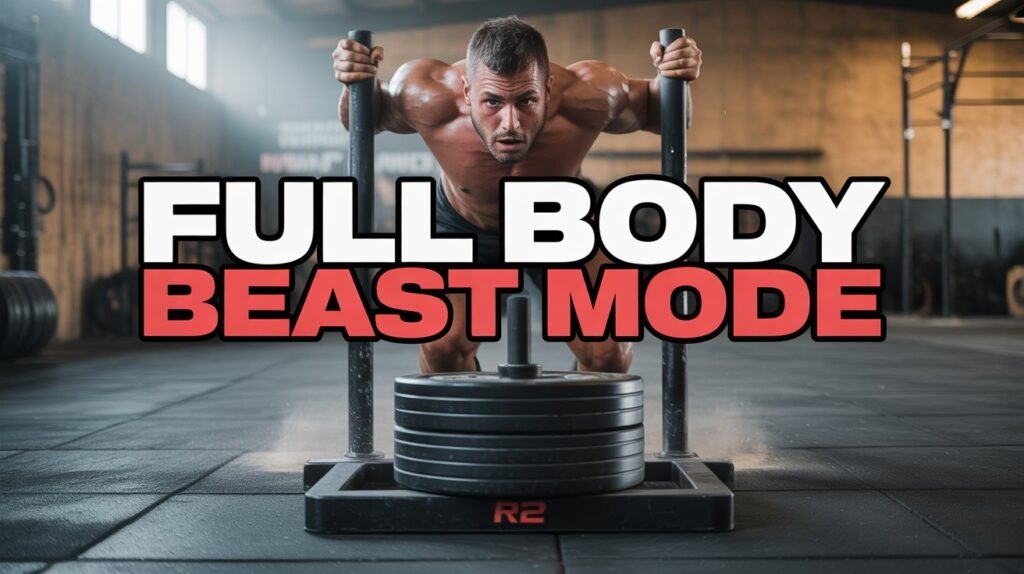
The Rage Fitness R2 Pull Sled is not just a piece of bent steel; it is a meticulously designed instrument intended to solve the most pervasive problems in the “grindset” of home fitness: space constraints, excessive noise, and the need for high-stability pulls. The unit features a compact architecture with dimensions measuring exactly 26.5 inches in length, 8 inches in width, and 16.5 inches in height. While some might think a sled this small is “delulu” for serious training, the material choice and weight distribution tell a different story. Constructed from high-tensile alloy steel, the sled itself maintains a base weight of approximately 10 to 15 pounds, allowing for extreme portability while maintaining the structural integrity required to handle a 90-pound plate load.
The “lore” of the R2’s stability lies in its single-post design. By utilizing a 2-inch diameter, 7-inch tall vertical pole centered on the sled’s longitudinal axis, Rage Fitness ensures that the center of mass remains low and perfectly aligned with the pull vector. This prevents the “wobble” or “fishtailing” often seen in dual-post sleds when the athlete’s gait is not perfectly symmetrical. For those looking to level up their home setup without the “clutter core” aesthetic of massive commercial equipment, the R2 offers a “snatched” footprint that fits under most power racks or in a standard car trunk.
Structural Integrity and Dimension Matrix
The following data represents the core physical properties of the R2 system, providing an expanded technical baseline for further biomechanical and financial analysis.
| Feature | Engineering Specification | Clinical/Athletic Benefit |
| Footprint (L x W x H) | 26.5″ x 8″ x 16.5″ | Space-saving, highly portable, and vertical storage compatible |
| Material Composition | Alloy Steel (High-Tensile) | Meticulously built to resist heavy turf, grass, and track abrasion |
| Loading Mechanism | 2″ Diameter Single Post | Low center of mass prevents fishtailing; utilizes your existing Olympic bumper plates |
| Post Height | 7 inches | Clean vertical clearance to stack ~2-3 standard 45lb bumpers or steel plates |
| Harness System | 6.5′ Straps with 6.5″ Padding | Comfortable, ergonomic force distribution on shoulders to eliminate raw friction |
| Weight Capacity | 90 lbs (Structural Limit) | Optimized for concentric speed, joint longevity, and metabolic conditioning |
| Waist Harness Size | 29 inches | Secure, non-slip fit tailored specifically for athletic and lean builds |
| Portability Factor | Ultra-Compact Framework | Easy to transport; fits effortlessly under power racks or inside a car trunk |
| MSRP Base Price | $99.99 USD | High-ROI entry point for home gym owners avoiding large commercial equipment costs |
| Current Market Value | $89.99 USD (10% OFF Sale) | Economically priced budget-killer; allows institutional facilities to scale volume purchases |
While the 90-pound limit might seem “lowkey” compared to the 500-pound capacity of the Titan Power Drag, the R2 is designed for a specific “aura”—the aura of speed and joint longevity. The friction physics of a smaller sled means that 90 pounds on high-pile turf can generate a horizontal resistive force (Fr) that challenges even elite sprinters.
Biomechanics of the Backward Drag: Bulletproofing the Knees
In the current era of “mewing” for aesthetic jawlines and “looksmaxxing” for physiques, the real “flex” is having knees that don’t sound like a bowl of Rice Krispies. The R2 Pull Sled has gained a “sigma” status among followers of the “Knees Over Toes” philosophy because of its efficacy in the backward sled drag. The “problem” many face today is chronic knee pain stemming from an over-reliance on eccentric-heavy movements like squats without sufficient concentric-only development.
The R2 solves this “skill issue” by providing a movement that is entirely concentric. When you drag the sled backward, the muscles shorten under tension without the subsequent stretching phase that causes muscle damage (DOMS). This allows the athlete to “cook” their quads and glutes daily without feeling “washed” or “cooked” the next morning. The R2’s 6.5-foot straps allow for a 45-degree body lean, which is the “rizz” required to properly target the Vastus Medialis Oblique (VMO), the “teardrop” muscle essential for knee stability.
Friction Physics and Force Production
The relationship between the sled and the surface is governed by the coefficient of friction (μ). For the R2, the force required to maintain motion (Fk) is calculated as follows:
Fk=μk⋅N
Where N is the normal force (the sum of the sled’s weight and the loaded plates). On standard artificial turf, μk can vary between 0.35 and 0.55. The R2’s runners are polished to ensure that while the resistance is high, the “vibe” of the pull remains smooth.
| Surface Type | Estimated Friction (μ) | Resistance Feel (90lb Load) |
| Artificial Turf | 0.45 | Moderate – High (Sprint focus) |
| Short Grass | 0.55 | High (Strength focus) |
| Smooth Concrete | 0.25 | Low – Noisy (Speed focus) |
| Rubber Gym Flooring | 0.85+ | Extreme (Grind focus) |
This friction variability means the R2 is essentially a “shape-shifter.” If you find that 90 pounds is too light on a track, moving it to grass or rubber flooring immediately “yasifies” the difficulty level without needing more plates.
Solving the “Home Gym Lore”: Space, Noise, and Neighbors
One of the biggest “unhinged” behaviors in the home gym community is trying to use a commercial-grade prowler in a 1-car garage. The “brain rot” of buying equipment that doesn’t fit your space is real. The R2 Pull Sled serves as the “antidote” to this problem. Most users currently face three primary issues:
- The Space Tax: Large sleds take up precious square footage. The R2 is so compact it can be hung on a wall peg.
- The Noise Complaint: Metal sleds on concrete sound like a demon being exorcised. The R2 is designed for grass and turf, and its lighter base weight reduces the “scrape” decibels.
- The Setup Fatigue: If it takes 20 minutes to set up a sled, you’re not going to use it. The R2 is “plug and play”—just drop a plate on the single post and go.
The R2’s 6.5-inch straps are equipped with heavy-duty padding to prevent “chafing aura,” ensuring that the only thing hurting after your workout is your quads. This “user experience” focus is why the R2 has 91% of respondents recommending it to their friends—it doesn’t just work; it’s actually “lit” to use.
Comparative Market Positioning
To understand why the R2 is the “sigma” of the budget sled world, we must compare it to its peers in 2026.
| Product | Price (Estimated) | Weight Limit | “Vibe” / Best Use Case |
| Rage Fitness R2 | $95 – $110 | 90 lbs | Portable “Knees Over Toes” goat |
| Titan Power Drag | $97 | 500 lbs | Budget heavy-dragger (Bulky) |
| Spud Inc Magic Carpet | $114 | 600 lbs | Ultimate portability (Nylon fabric) |
| Rogue Echo Dog Sled | $255 | 450+ lbs | The “American Made” tank |
| Torque Tank M1 | $700+ | Magnetic | The “Silent but Deadly” rich kid choice |
The “tea” here is that while the Spud Inc Magic Carpet is more portable, it often “caps” out on performance because the nylon can bunch up or catch on uneven turf. The R2, being steel, gives you that “smooth pull” that keeps your momentum from being “cooked” mid-set.
Metabolic “Lore”: Sled Training for the Shred
For those in a “cutting” phase or trying to avoid “dad bod” energy, the R2 Pull Sled is a metabolic furnace. Pushing or pulling a sled with near-maximal effort is one of the few ways to perform “Neuro-Kinetic HIIT”—training your fast-twitch fibers without the “CNS burnout” associated with heavy barbell work.
The science suggests that sled pushes and pulls increase your VO2 max and “shred” body fat by creating a massive “oxygen debt”. Because the R2 allows you to “take off and add weight easily,” you can perform “Drop Sets” on the fly. Start with 90 lbs for a 20m drag, drop to 45 lbs for a 20m sprint, and finish with an empty sled for a high-knee burn. That’s “peak performance” in just 60 seconds.
To get the most out of these metabolic protocols, you’ll need a harness that doesn’t “gatekeep” your breathing.👉 The R2’s harness is specifically “yassified” for comfort, as seen in the specs here: 👈
Training Phases and Programming
A typical “let them cook” training cycle for the R2 involves three distinct phases designed to maximize its 90lb capacity.
- The Foundation (Weeks 1-2): High-volume backward walks. 10 sets of 30 meters at 45 lbs. Focus on “Ass to Grass” depth and joint lubrication.
- The Power Surge (Weeks 3-4): Heavy drags. 6 reps of 15 meters at 90 lbs. Rest 90 seconds. This is for the “gains”.
- The Speed Check (Weeks 5-6): Weighted sprints. 8 sets of 20 meters at 25 lbs. Max effort. This builds that “explosive rizz” on the track.
The “SLED” Market and Economic Reality
In the professional world, “SLED” also stands for State, Local, and Education markets, which are currently seeing a surge in equipment procurement for high school and collegiate weight rooms. The Rage Fitness R2 is perfectly positioned for this “close-out” fiscal cycle because it is “economically priced to fit your budget”. Athletic directors are realizing that instead of one $3,000 motorized treadmill, they can buy 30 R2 Pull Sleds and train the entire football team at once.
This “piggybacking” of consumer trends into the institutional market is “no cap” the reason Rage Fitness has stayed relevant. The R2 isn’t just a toy for “gym rats”—it’s a “certified” piece of conditioning hardware used in ACFT (Army Combat Fitness Test) training and professional athletic labs.
Institutional and Consumer Durability Ratings
| Stress Factor | R2 Rating (1-10) | Reasoning |
| Abrasive Wear | 8 | Thick steel runners hold up well on turf |
| Strap Strength | 9 | Nylon straps are double-stitched for high-tension pulls |
| Weather Resistance | 7 | Powder coating prevents rust, but don’t leave it in the “Ohio” rain |
| Ease of Assembly | 10 | Comes out of the box ready to “slay” |
If you have stepped into a gym recently, you’ve probably seen people violently pushing or pulling a heavy piece of metal across the turf while looking like they are questioning every life choice they’ve ever made.
Sled training—whether you call it a prowler, a fitness sled, or a weight lifting sled—has completely taken over the fitness world, largely thanks to hybrid races like Hyrox. But is it all hype, or is the sled truly the ultimate fitness cheat code?
Here is the ultimate, no-nonsense FAQ on everything you need to know about heavy sled workouts.
The Ultimate Masterclass FAQ: Sled Pushing, Pulling, and Training Secrets
If you’ve been scrolling through fitness content lately, you’ve probably noticed that the weighted sled has officially achieved legendary status. From functional fitness boxes to Hyrox courses and physical therapy clinics, everyone is talking about pushing and pulling heavy metal.
But with all the hype comes a ton of questions—and some absolute bro-science. We are breaking down every single burning question you have about sled mechanics, technique, and gear selection so you can optimize your routines and build unstoppable performance.
Biomechanics, Knee Health, and Science
1. Why did sled pulls destroy my knees?
The internet loves to talk about how sleds are a magic cure-all for joints, but if you jumped straight into heavy sled pulls and your knees are screaming, you’ve hit a classic roadblock. Sled work is generally safe, but it can destroy your knees under three specific conditions:
- Heel-Striking Shock: If you are dragging a sled backward and violently slamming your heels into the turf, you are sending a harsh braking force straight up through your shins and patellar tendons.
- The Aggressive Lockout: Snap-locking your knees out straight on every step under extreme load creates a nasty shear force on the joint capsule.
- Overloading the System: Trying to move a truck-sized load before your tendons have built up the necessary cellular density.
2. Why are reverse sled pulls so good for knee pain when studies show the eccentric phase is better for physical therapy?
This is an incredible question that trips up a lot of fitness nerds. You are 100% correct: traditional sports medicine relies heavily on eccentric training (the lowering/lengthening phase of a movement, like a slow Romanian deadlift or a Spanish squat) to stimulate collagen synthesis and fix tendinopathies.
So why does the concentric-only (muscle-shortening) reverse sled pull get so much love?
The answer lies in metabolic flushing and safety thresholds. Eccentric training causes micro-tears in the muscle fibers, resulting in delayed onset muscle soreness (DOMS). If someone has highly inflamed, arthritic, or severely injured knees, heavy eccentric loading can easily push them past their pain threshold, causing a massive flare-up.
Reverse sled pulls allow you to pump an astronomical volume of oxygenated blood directly into the quadriceps and patellar tendons with virtually zero muscle damage. It acts as a mechanical pump, washing away metabolic waste and bringing healing nutrients to the joint without the destructive mechanical stress of a heavy eccentric drop.
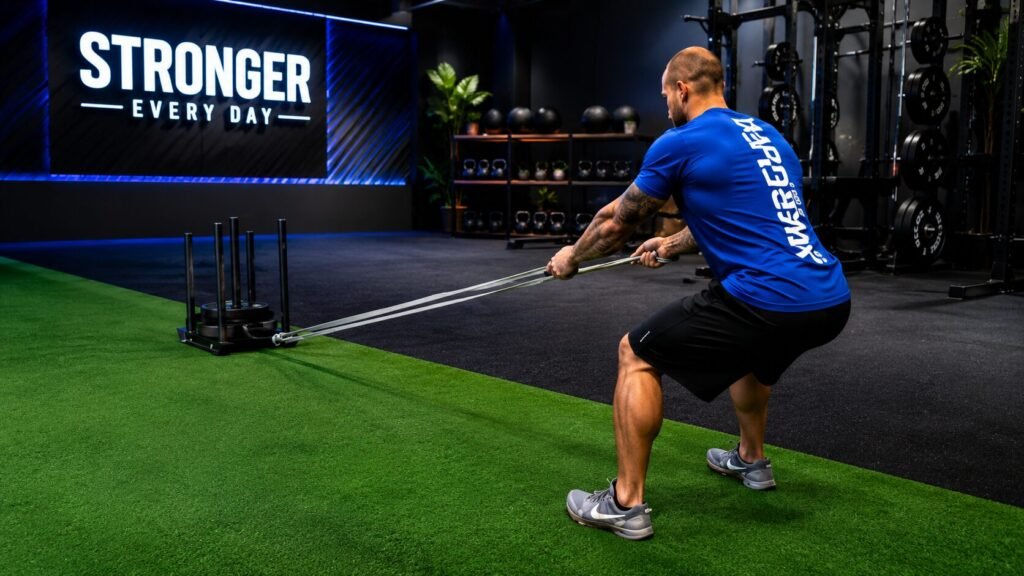
3. Is sled pulling/pushing once a week sufficient for growth?
If your primary goal is conditioning, aerobic capacity, or maintaining joint health, once a week is absolutely sufficient to move the needle. However, if you are looking for localized muscular hypertrophy (growth) in your quads, hamstrings, and glutes, you need to look at total volume.
Because sled work lacks an eccentric phase, it doesn’t trigger muscle growth via structural damage the way squats do. Instead, it drives growth through metabolic stress. To optimize this once a week, you have to make those sessions brutal—think sustained, heavy-loaded carries or high-intensity intervals that leave your legs entirely filled with lactic acid. For serious mass gains, 2 to 3 shorter, targeted sessions per week yield far better results.
Gear, Setups, and Troubleshooting
4. Which piece of equipment is best for sled/tire pulls? Sled harness or pulling belt?
The choice between a full-body sled harness and a pulling belt completely changes the muscular demands of the movement:
| Equipment Type | Attachment Point | Primary Muscle Focus | Best Used For |
| Pulling Belt (Waist/Hips) | Low on the pelvis | Pure legs (quads/glutes), zero spine compression | Knee rehab, sprint speed, pure lower-body hypertrophy |
| Sled Harness (Shoulders/Torso) | High on the upper back | Massive core, upper back, and posterior chain bracing | Tactical prep, strongman training, absolute raw power |
5. Are sled pulls tied to your WAIST or also the upper body?
They can be both! If you wrap the strap around your waist, you isolate your legs and completely remove the upper body from the equation. If you use an upper-body harness or hold a heavy rope, your core, shoulders, and back have to stay locked in a brutal isometric hold to transfer power from your feet into the sled.
6. Diagnose the Problem: Shoes Slipping on the Sled Pull
If you are driving hard but your shoes are skating all over the place, your workout is dead in the water. You are losing force transfer to the ground.
- The Culprit: Running shoes with thick, squishy foam midsoles. They compress under pressure, changing your foot angle and causing the tread to lose its grip. Smooth indoor running shoes will also slide right off synthetic turf.
- The Fix: You need a shoe with a harder, low-profile midsole and aggressive rubber traction. Trail running shoes, dedicated cross-trainers (like Nanos or Metcons), or even outdoor turf cleats are mandatory for transferring raw power into a heavy sled.
Technique and Pro-Tips
7. Is the sled pull technique of walking back really important?
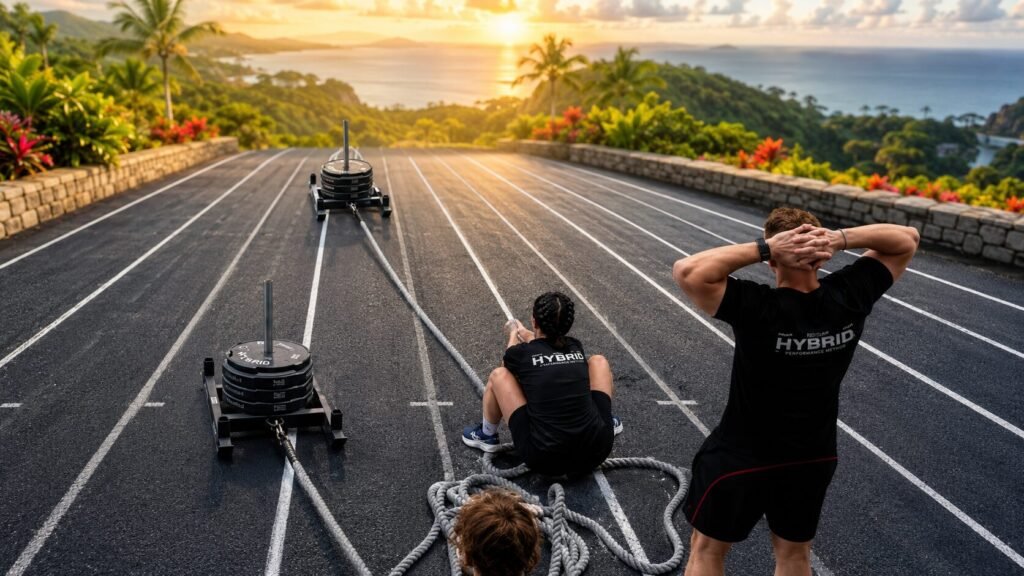
Yes, it is the fundamental base of the movement. When performing a standard rope pull or strap drag, keeping your hips low and stepping directly backward keeps your center of gravity anchored.
However, if you are tackling a Hyrox-style rope pull, the game changes entirely. You don’t just stand there arms-only pulling. Check out the proper competition setup below:
8. How do I turn the sled pull around?
When you hit the end of your turf lane and need to bring the sled back, efficiency is everything. Don’t waste energy lifting or dragging the heavy frame around.
1.Stop and Drop:Instantly drop tension.
Walk forward toward the sled to create slack in your straps or rope line. Never try to turn a loaded sled while the line is tight.
2.Disconnect or Unhook:If using a single-point connection.
Unclip your carabiner or loop from the front hook and quickly run it to the opposite side’s tow hook.
3.The Pivot Round:For dual-strap setups.
If your belt has dual straps, simply drop your hips, pivot 180 degrees on the balls of your feet, and walk through the center of the straps so they clear your legs cleanly.
9. Sled push and pull tips: “Fixing your slack pull”
The Golden Rule: Treat the sled rope exactly like a heavy deadlift barbell.
If you’re aiming for big numbers—like visualising a massive 480×2 tonight on the deadlift platform—you know you can’t just rip the bar off the floor without tension; you have to pull the slack out of the bar first.
The same applies to the sled pull rope. If there is loose slack in the rope and you try to pull aggressively, you will experience an instant drop in force, slip your stance, or kill your momentum. Reach out, pull the line completely taut until you feel the heavy dead-weight of the sled, and then execute your full-body explosive drive.
The Rookie Hyrox Guide
10. How hard is the sled push/pull, and what is a good target weight vs. body weight?
The absolute difficulty of a sled depends entirely on the surface friction. Pushing 300 pounds on sleek, hard plastic runners over fresh turf feels radically different than pushing it over rubber gym mats or outdoor grass.
As a general baseline for gym training outside of formal competitions, a solid target benchmark is to build up to pushing 1.5x to 2x your body weight, and pulling 1x to 1.5x your body weight.
11. What is a reasonable timing for a first-timer with zero fitness background doing a Hyrox Relay?
If you have been thrown into a Hyrox Relay with zero formal training, don’t panic! The relay splits the workload completely, meaning you only have to survive your specific assigned stations.
The two stations that completely shock a beginner’s central nervous system are the Sled Pull and the Wall Balls. To help you pace your strategy perfectly and visualize your targets, use the calculator below to see what a realistic performance looks like based on your starting point.
Hyrox Strategy Calculator
| Category | Actionable Advice |
|---|---|
| Pacing Plan | Lean back and use body weight. Consistent 2-meter pulls. |
| Muscle Focus | Quads, Glutes, Rhomboids |
| Survival Tip | Drive your feet into the floor like you’re starting a sprint. |
12.Are sleds actually a good workout?
Look, they aren’t just a good workout; they are arguably one of the most efficient tools in the entire gym. Sled work hits you with a brutal mix of cardio conditioning and raw power development.
The magic of the sled lies in something called concentric-only loading. Unlike a squat or a bench press where you have to lower the weight (eccentric phase), the sled only requires force when you are pushing or pulling it forward.
The Big Benefit: Because there is no eccentric phase, muscle damage and subsequent soreness (DOMS) are incredibly low. You can absolutely torch your lungs and muscles today and still be able to walk tomorrow.
13.Are sled pushes bad for the knees?
It is actually the exact opposite. Sled pushes and backward sled pulls are legendary for knee rehabilitation and joint longevity.
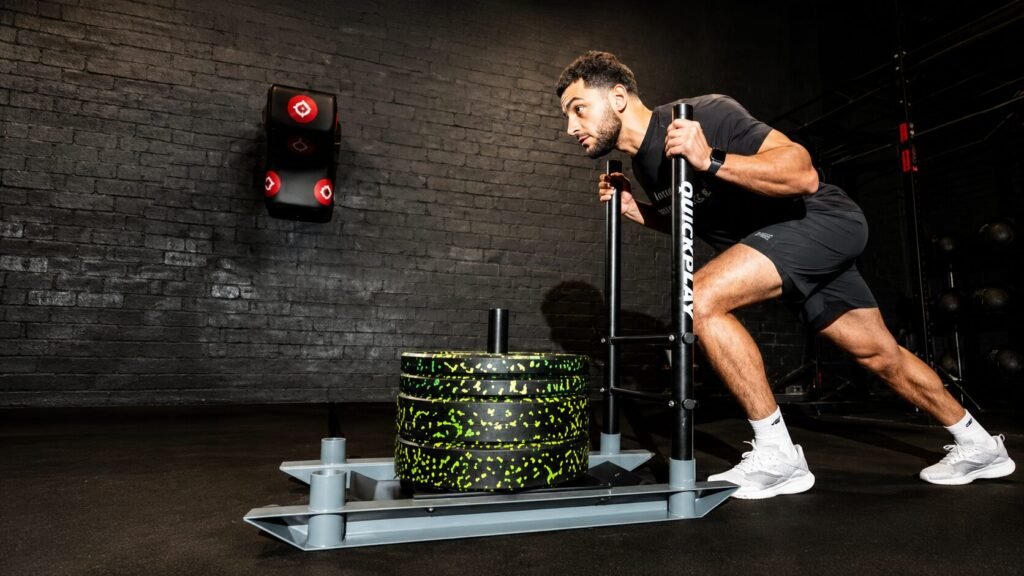
Take a close look at the mechanics in the image above: the athlete is forcing a steep ankle angle and driving directly through the balls of his feet. This specific position forces massive blood flow straight into the quads and the patellar tendon without the brutal, joint-crushing compression of a heavy barbell sitting on your spine.
Pro-Tip: If you struggle with cranky knees, try hooking up a harness or strap to a pull sled (like the Rage Fitness R2 or a standard fitness sled) and walk backward for 5 to 10 minutes. It builds up the vastus medialis oblique (VMO)—the tear-drop muscle over your knee—providing bulletproof stability.
14.Do sled pushes increase testosterone?
The short answer is yes, but let’s clear up the bro-science. Sled pushes themselves don’t possess a magical hormone-boosting secret. However, heavy, high-intensity compound movements that recruit large muscle groups are proven to trigger an acute spike in growth hormone and testosterone production.
Because a heavy sled push forces your glutes, hamstrings, quads, calves, core, and upper body to fire simultaneously at maximum effort, your endocrine system responds by ramping up hormone production to handle the physical stress.
15.How heavy is the Hyrox sled pull?
If you are training for a Hyrox race, you need to know exactly what you are up against. The sled pull is Station 3, and the weights are strictly standardized worldwide. The total weight includes the physical weight of the sled itself plus the loaded plates.
| Hyrox Division | Sled Pull Weight (Incl. Sled) | Sled Push Weight (For Comparison) |
|---|---|---|
| Women’s Open | 78 kg (approx. 172 lbs) | 102 kg (approx. 225 lbs) |
| Men’s Open / Women’s Pro | 103 kg (approx. 227 lbs) | 152 kg (approx. 335 lbs) |
| Men’s Pro | 153 kg (approx. 337 lbs) | 202 kg (approx. 445 lbs) |
Pro-Tip: Carpet and turf friction vary wildly from gym to gym. A 103 kg sled pull on slick, brand-new turf might feel like a breeze, while that exact same weight on sticky rubber tiles or worn-out carpet will feel like pulling a literal truck. When training, don’t just chase numbers—train for the feeling of maximal resistance.
16.Why is the sled pull so incredibly hard?
The sled push lets you use your body weight to lean into the machine. The sled pull forces you to stand your ground and fight friction with raw friction of your own.
It is a true full-body execution. There is zero mechanical advantage, the rope stretches slightly (absorbing some of your power), and you are forced to stay inside a tiny 2-meter box. Every single rep requires you to re-engage your core and recreate momentum from a dead stop.
17.What muscles does the sled pull work?
While the sled push is incredibly quad-dominant, the sled pull flips the script entirely and attacks your posterior chain and upper body pull mechanics.
- The Lower Body: Your hamstrings, glutes, and calves take the brunt of the load as you brace, squat low, and drive your hips back. Edge | Training & Workout App for Running & Strength
- The Upper Body: Your lats, rhomboids, rear delts, and biceps are constantly engaged as you hand-over-hand reel in the heavy rope.
- The Hidden Killers: Your grip strength and core will likely fail first. Gripping a thick rope under heavy tension taxes the forearms and forces your core to stay completely locked to protect your lower back.
18.Shopping or Replacing Parts?
If you are looking to bring one of these into your garage gym or need to fix a unit up (like sourcing replacement straps or hardware for a Rage Fitness R2 pull sled), always prioritize heavy-duty steel construction and thick, braided nylon straps. A quality fitness sled is virtually indestructible, meaning it’s an investment that will outlast almost every other piece of cardio gear you own.
More Top-Tier Gear to Upgrade Your Daily Lore
Optimizing your fitness lore with the Rage Fitness R2 is just step one to avoiding a “mid” lifestyle. If you are serious about upgrading your overall health stack and keeping that main character energy across all your daily routines, you need to audit the rest of your environment. For the days when you aren’t torching your quads on the turf, keeping active during remote work is a total hack; check out our comprehensive Toputure Review 2026: Best Walking Pads & Exercise Bikes for Home Office Fitness (Tested) to keep your daily steps high without any setup fatigue. If your athletic pursuits take you out of the home gym and onto the court or course, don’t let bad gear ruin your aura—discover why your swing might be cooked in Why Your Stock Shaft Fails—And How Jupiter Lite 9 Wood Fixes It, or dive into the latest tennis and golf gear tech with our look into Is Dunlop 2026 the Comeback of the Year? The FX 500 & ZXiR Irons Review.
Of course, elite output requires pristine recovery, clean air, and top-tier nutrition so you never look washed. Ensure your indoor training space doesn’t have unhinged air quality by reading our Atmocube Review: Smart Indoor Air Quality Monitor for Healthier Homes & Offices. When it’s time to fuel your muscle protein synthesis, make sure you’re cooking like an absolute pro; avoid ruined meal prep with our guide on Why Your Steaks Turn Grey: Alva Maestro 5-Ply Review, and dial in your ultimate pre-workout fuel using the OutIn Fino Portable Electric Coffee Grinder Review (2026): Best Travel Espresso Grinder. Finally, round out your full-body longevity and hygiene optimization so your health is completely snatched by checking out our breakthrough hack, Tired of Failing Your Dental Checks? The 3-Sided Sonic Secret to a Flawless Smile.
Rage Fitness Buyer’s Guide: Shipping, Returns & Warranty
If you are ready to pull the trigger on a new sled or upgrade your home gym layout, you need to know how the logistics work. Rage Fitness ships directly from their main warehouse in Denver, Colorado (80239).
Here is the exact, no-nonsense breakdown of their customer service rules, shipping timelines, and protection policies.
Shipping Timelines & Delivery Expectations
Rage Fitness utilizes standard ground networks (FedEx, UPS, and USPS) along with heavy motor freight carriers for larger conditioning equipment.
- Standard Orders: Typically processed within 3 to 4 business days. Once it leaves the warehouse, standard transit takes an additional 3 to 5 business days (excluding weekends and holidays).
- Heavy or Custom Gear: Large commercial items and custom builds generally take 2 to 4 weeks to manufacture and ship.
- Ground Delivery: If you aren’t home, ground packages may be left at your front door or entrance at the delivery driver’s discretion.
🚨 Critical Warning for Freight Deliveries: If your equipment arrives via a motor freight carrier (like FedEx Freight or Old Dominion), you must inspect the package before signing for it. If you notice any transit damage, you must write it down on the delivery receipt while the driver is still present. If you do not note the damage on the paperwork immediately, neither Rage Fitness nor the freight company will cover the replacement claim.
Quick-Glance Policy Matrix
| Policy Type | Timeframe / Limit | The Core Rules You Need to Know |
| Standard Returns | 10 Days from delivery | Must be brand new, unused, and in original packaging. You must contact support first to get an RMA number. |
| Return Freight Cost | Buyer’s Responsibility | You are responsible for paying all return shipping and freight charges back to the warehouse. |
| Clearance Items | Final Sale | No refunds, returns, or exchanges are allowed on clearance gear. |
| Custom Orders | No Cancellations | Once a custom order is processed, it cannot be canceled, returned, or refunded. |
| Equipment Warranty | 1 Year from invoice date | Covers faulty manufacturing and material defects. Does not cover normal wear and tear or extreme usage damage. |
Hardware Warranty & California Prop 65
Every piece of hardware (excluding gymnastics grips) is backed by a one-year manufacturer’s warranty from your original invoice date. If a component is genuinely defective, the company will either repair the part or issue a refund at their expense. Note that you may be required to pay the upfront shipping costs to send the item back to Denver for inspection.
California Proposition 65 Notice: In compliance with California safety rules, you will see a standard warning label on these products regarding potential exposure to everyday elements like lead, brass, or PVC. This is a standard structural requirement for a massive array of fitness gear, electronics, and lifestyle goods sold throughout the state.
Rage Fitness Customer Support Details
If you need to secure a Return Merchandise Authorization (RMA) number, check stock availability, or get a custom quote for a commercial gym space, use the direct channels below:
- Official Support Email:
info@ragefitness.com - Direct Phone Line:
(303) 937-1012
Conclusion: The Final Fit Check
The Rage Fitness R2 Pull Sled is the ultimate “sigma” move for anyone tired of the “gatekeeping” in the high-end fitness world. It solves the “knee lore” problems with backward drags, defeats the “space tax” with its compact size, and offers “no cap” value for under a hundred bucks. Whether you’re recovering from an ACL “skill issue” or just want to “glow up” your conditioning, the R2 is the “GOAT” of portable resistance.
Don’t let your training be “mid”—grab the sled that’s actually “bussin” and start your journey to being “shredded” today. The path to “peak aura” starts with a single pull, 👉and the best place to find your gear is right here: . 👈